Melamine tableware: a complete guide for restaurants, caterers and resellers
By FITTO Trade Desk · Last updated 29 October 2026
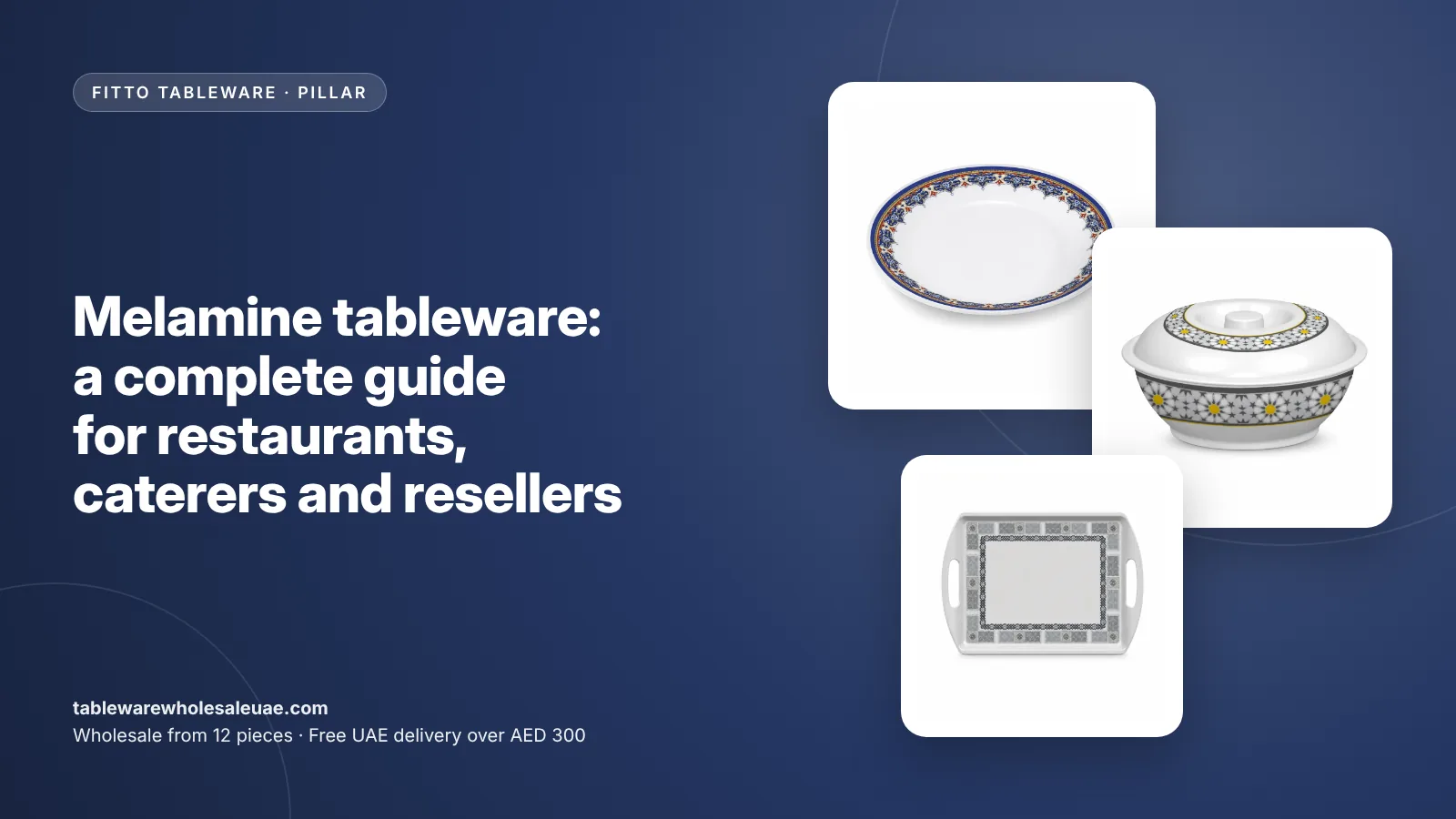
Melamine tableware wholesale suits any business that serves a lot of people where breakage, weight or outdoor use is a problem. It is light, shatter-resistant and moulded in bright patterns. Use it for serving hot or cold food, never for microwaving or cooking, and buy matching plates, bowls and trays from one pattern family.
Key takeaways
- Melamine is a hard, shatter-resistant plastic for serving food, not for heating it: keep it out of microwaves, ovens and hobs.
- It suits terraces, poolside venues, buffets, catering, canteens and children's tables, where glass and ceramic break.
- Buy by pattern family, so plates, bowls, trays and ladles match and can be topped up later.
- Most melamine is dishwasher safe; soft sponges and no long bleach soaks keep the surface glossy.
- Retire pieces that are cracked, blistered, deeply scratched or permanently stained.
Every broken plate on a busy terrace costs you twice: once to replace it and again in the minutes staff spend sweeping glass while guests wait. Melamine (ميلامين) fixes that, but only if you buy the right pieces and use them the right way. This guide settles what melamine is, where it works, how to care for it and how to buy it in bulk.
It is for restaurants, caterers, outdoor venues and resellers in the UAE. At FITTO Tableware, a wholesale plates and bowls supplier in the UAE, melamine is our largest material range, with about 120 melamine products from 3.5-inch rice bowls to 60 cm round trays.
What is melamine tableware?
Melamine tableware is made from melamine-formaldehyde resin, a hard plastic that is moulded under heat and pressure into plates, bowls and trays. Once set, it cannot be melted and reshaped like ordinary plastics.
The result is lighter than ceramic or glass and much harder to break. Patterns are usually printed on a paper layer that is moulded into the surface under a clear glaze. That is why melamine can carry detailed florals and geometric borders that do not rub off in normal washing.
Three properties matter most to a buyer:
- Shatter resistance: melamine rarely shatters when dropped, though it can chip or crack after a hard knock on stone or tile.
- Weight: an 8-inch melamine salad bowl weighs about 450 g, and a melamine mug about 180 g, so staff carry more per trip.
- Heat limit: melamine is made to receive hot food, not to be heated itself.
Is melamine tableware safe for food?
Yes, melamine is safe for serving food when it is used as intended: for serving, not for heating or cooking. The key rule is to keep it out of the microwave, oven and direct heat.
Food safety agencies, including the US Food and Drug Administration and Germany's Federal Institute for Risk Assessment (BfR), advise against heating food in melamine. The BfR recommends that melamine tableware is not heated above about 70 °C. High heat, and long contact with hot acidic food, can increase how much of the material passes into food.
In practice that means:
- Serve freely: hot machboos, curry, soup, grills and cold salads are all normal use.
- Never reheat: reheat in microwave-safe opal glass, glass or ceramic, then plate onto melamine.
- Avoid long hot holding: do not keep melamine under heat lamps or on hot plates for long periods.
- Limit long acidic contact: do not store tomato sauces, pickles or lemon dressings in melamine for hours.
- Retire damaged pieces: replace plates that are cracked, blistered or deeply scratched.
Our quick answer on whether melamine is microwave safe explains the heating rules in more detail. Train new staff on them, because one microwave mistake can ruin a plate.
Where does melamine tableware work best?
Melamine works best wherever glass and ceramic break too often or are too heavy to carry: outdoors, at buffets, in catering and with children. It is less suited to fine dining, where weight and feel are part of the experience.
| Setting | Why melamine fits | Pieces to start with |
|---|---|---|
| Terraces, poolside and beach venues | No broken glass near pools or bare feet | 10-inch dinner plates, salad bowls, round trays |
| Buffets and hotel breakfast | Light to carry, refill and clear | Lidded serving bowls, oval platters, ladles |
| Outdoor catering and desert camps | Survives transport and uneven ground | Rectangular handled trays, lidded bowls |
| Staff canteens and accommodation | Fast turnover, low breakage | Dinner plates, rice bowls, soup plates |
| Schools and children's areas | Light and safer if dropped | 7-inch plates, 4.5-inch rice bowls |
| Majlis, iftar and family gatherings | Large shared trays and platters | 45–60 cm round trays, 17-inch oval plates |
UAE conditions favour melamine for half the year. From October to April, terraces, desert camps and garden events fill up, and that is when glass breakage is most costly. In summer, hotel pool decks and indoor buffets keep it in use.
Where melamine is not the best fit, choose another material:
- Reheating and à la minute plating: opal glass or ceramic. See our comparison of melamine vs opal glass plates.
- Heat lamps, ovens and hot holding: stainless steel trays and pans.
- Formal dining: ceramic or opal glass, which feel heavier and more refined.
How does melamine compare with opal glass, ceramic and stainless steel?
Melamine wins on breakage and weight, opal glass on microwave use and look, ceramic on feel, and stainless steel on heat and durability. Most venues use two materials, not one.
| Factor | Melamine | Opal glass | Ceramic | Stainless steel |
|---|---|---|---|---|
| Breakage when dropped | Rarely breaks | Can break | Breaks or chips | Does not break |
| Weight | Light | Medium | Heavy | Light to medium |
| Microwave | No | Yes, if marked | Usually, if marked | No |
| Look | Bright patterns | Clean white | Classic, varied | Industrial, shiny |
| Best for | Outdoor, buffet, kids | Indoor dining, reheating | Fine dining, cafés | Canteens, prep, hot holding |
For serving trays specifically, read our comparison of melamine vs steel serving trays.
Which melamine pieces and sizes should you buy?
Build a melamine set around five pieces: a 10–11 inch dinner plate, a 9-inch soup plate, a 4.5-inch rice bowl, an 8-inch salad bowl and a handled serving tray. Add lidded bowls, oval platters and ladles for buffets.
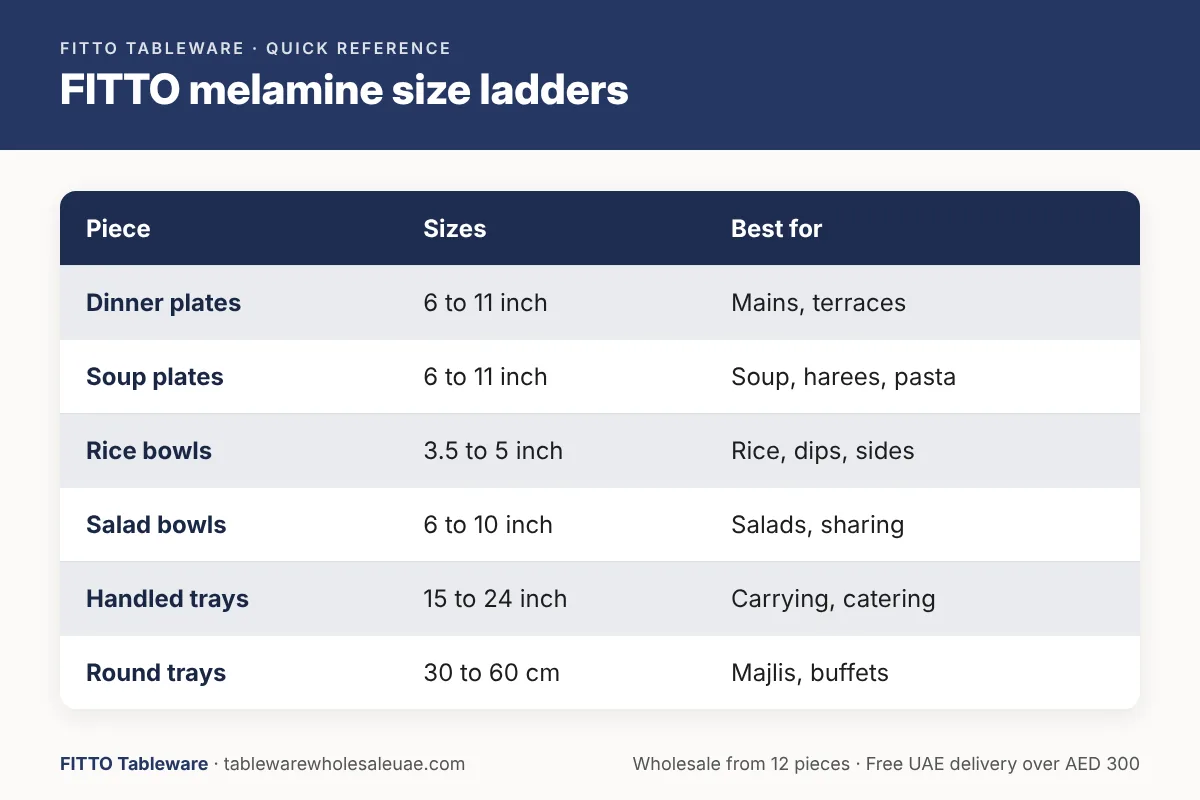
FITTO melamine comes in these size ladders:
| Piece | Sizes in the range | Notes |
|---|---|---|
| Dinner plates | 6, 7, 8, 9, 10 and 11 inch | The 10-inch measures about 26 cm |
| Soup plates | 6 to 11 inch | A 9-inch soup plate is about 23 × 23 × 4 cm |
| Rice bowls | 3.5, 4, 4.5 and 5 inch | A 3.5-inch bowl is about 10 × 10 × 6 cm |
| Salad bowls | 6 to 10 inch | A 10-inch bowl is about 27 cm wide and 10 cm deep |
| Lidded serving bowls | 8, 9 and 10 inch | Keep food covered on buffets |
| Wavy oval serving plates | 12, 14 and 17 inch | The 14-inch is 37 × 27 × 5 cm |
| Rectangular handled trays | 15, 18, 20, 22 and 24 inch | From 39 × 27 cm up to 61.5 × 42 cm |
| Round serving trays | 30 to 60 cm | Wavy, woven-look and patterned styles |
| Ladles and spoons | 14–15 cm soup spoons; 30–32 cm ladles | Match the plate pattern |
For restaurants and cafés
A 10-inch white melamine dinner plate suits most mains, while an 11-inch plate handles mixed grills. Pair it with 4.5-inch rice bowls and 9-inch soup plates for Arabic and South Asian menus.
For caterers and buffets
Lidded serving bowls, such as the 10-inch white floral lidded serving bowl, keep salads and hummus covered from the van to the table. Rectangular trays with handles, such as the 20-inch tray at 53 × 38 cm, carry food safely and stack flat in transport.
For resellers and gift shops
Shoppers buy for the whole table, so stock complete pattern families. A 55 cm round woven-look serving tray is a strong centrepiece for Ramadan and Eid hosting, when large shared trays sell well.
Which melamine patterns sell, and how do pattern families work?
Choose patterns that come in plates, bowls, trays and ladles, so customers can build or top up a full set. A single pattern with only one piece is hard to sell and hard to replace.
Common pattern families in the FITTO range include:
- White with floral border: soft grey and yellow florals, the easiest all-rounder for homes and cafés.
- White and grey with yellow accents: salad bowls, oval plates and trays in a matching look.
- Grey geometric border: a modern choice for restaurants and young households, from 3.5-inch rice bowls to 11-inch plates.
- White with blue floral border: a traditional look that suits majlis and family dining.
- Plain white with decorative rim: a safe base that mixes with any serving pieces.
For restaurants, a plain white or subtle border makes food the focus and makes replacement easy. For retail, a bold pattern photographed as a full table setting sells better than a single plate. Check that the pattern lines up evenly around the rim on your sample before buying in bulk.
How do you clean and care for melamine?
Wash melamine with warm water, mild detergent and a soft sponge, or in a dishwasher if the line is marked dishwasher safe. Avoid steel wool, scouring powders and long bleach soaks, which dull the glaze and invite stains.
- Stains: tea, turmeric and tomato can mark melamine. A paste of baking soda and water on a soft cloth lifts most light stains.
- Knives: serrated steak knives scratch the surface over time. Scratches hold stains, so serve heavy grills on steel or a dedicated plate.
- Drying: stack only when dry, and keep stock out of direct sun, which can fade patterns over time.
- Inspection: check for cracks, blistering and deep scratches each month, and retire damaged pieces.
Our step-by-step guide on how to clean melamine plates covers stain removal in detail.
How much melamine should you buy in bulk?
Order two to three plates per seat for a restaurant, about 1.5 per guest for an event, and one sample of each new pattern first. These are rules of thumb; adjust for your menu, washing speed and service style.
- Count your covers. A 60-seat terrace with steady turnover needs about 120–180 dinner plates.
- List each piece by course. Plates, soup plates, rice bowls, salad bowls and serving pieces.
- Choose one pattern family. It keeps reorders simple and the table consistent.
- Order samples. Check weight, finish, rim smoothness, pattern alignment and that the base sits flat.
- Plan a top-up stock. Keep about 10% extra of the most used pieces for chips, losses and peak days.
- Reorder before peaks. Top up before the winter outdoor season and before Ramadan.
Resellers can start with two pattern families in the core pieces, then add trays and lidded bowls once the plates sell through.
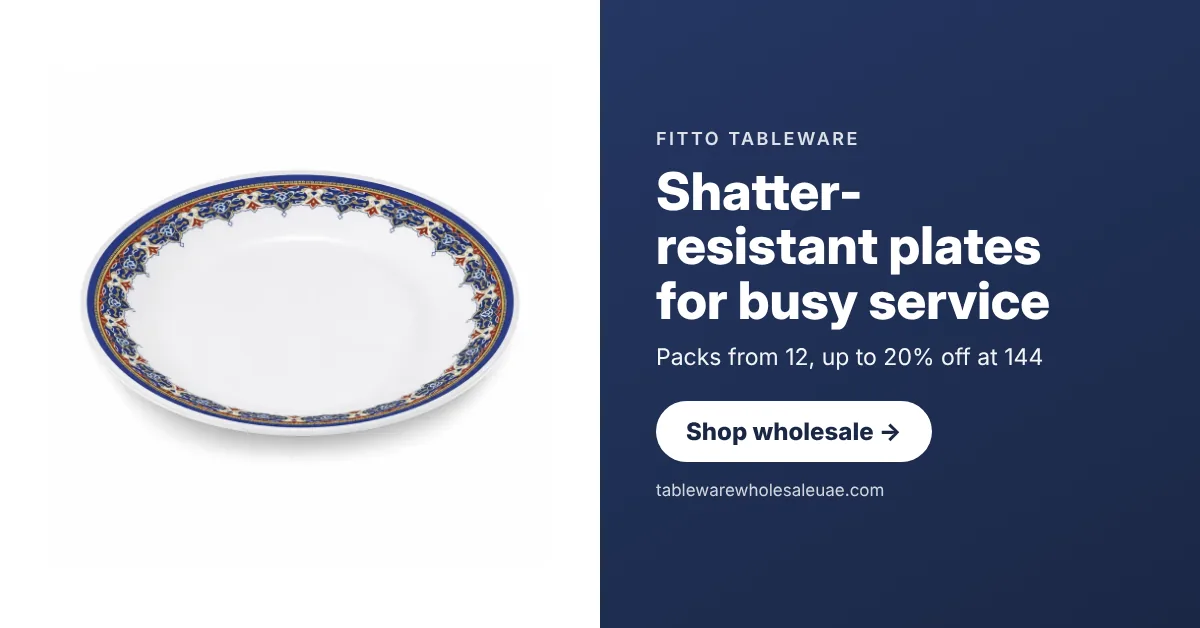
FITTO Trade Pick: A melamine starter set for busy service Build around the 10-inch white melamine dinner plate, the 4.5-inch floral melamine rice bowl, the 8-inch grey geometric salad bowl and the 20-inch handled serving tray. Packs run from 12 to 144 pieces, and the bigger pack saves up to 20% per piece.
The bottom line
Melamine is the practical choice for outdoor, buffet, catering and family service, as long as it is used for serving and never for heating. Buy by pattern family, wash it gently and retire damaged pieces, and it will save you money on breakage season after season.
Browse our wholesale plates and bowls and serving trays and platters, request a quote for a full melamine set, or order a sample with its cost credited on a bulk order of AED 2,000+ within 30 days. Questions? WhatsApp +971 55 672 6947. FITTO Tableware: fit for the way you serve.
FAQ
Is melamine unbreakable?+
Melamine is shatter-resistant rather than unbreakable. It rarely breaks when dropped from table height, and it does not shatter into sharp shards like glass. A hard knock on stone or a heavy impact can still chip or crack it. Replace cracked pieces, because cracks trap food and bacteria and weaken the plate further.
Can melamine hold hot food?+
Yes. Serving freshly cooked hot food, such as rice, curry, soup or grilled meat, on melamine is normal use. What melamine should not do is go into a microwave or oven, sit under heat lamps for long periods or hold acidic food for hours. Reheat food in opal glass or ceramic first.
Is melamine dishwasher safe?+
Most melamine is dishwasher safe, but check the marking on the base or packaging of each line. Use the normal cycle and avoid harsh chlorine-based detergents or long bleach soaks. Space pieces so water reaches every surface, and dry them fully before stacking so water marks do not build up.
How long does melamine tableware last?+
With gentle washing and no microwave use, melamine can stay in service for several years in a home and for many months in a busy restaurant. Its life ends when the surface becomes dull, scratched, blistered or stained. Inspect stock regularly and retire worn pieces before guests notice them.
Is melamine good for children?+
Melamine is popular for children because it is light and does not shatter if dropped. Use it for serving, never for heating milk or food in the microwave, and wash it gently. Check the age guidance and care notes on the label, and supervise young children at the table as usual.
What is the difference between melamine and plastic tableware?+
Melamine is a hard, heat-set resin that feels close to ceramic and keeps its shape. Ordinary plastic tableware, such as polypropylene, is softer, lighter and often used for picnics or storage. Melamine looks more like real dinnerware and resists scratches better, but unlike some polypropylene it is not microwave safe.