Hotel and restaurant tableware: a complete guide to equipping dining rooms and buffets
By FITTO Trade Desk · Last updated 29 October 2026
Choosing a hotel tableware supplier in the UAE starts with your outlets, not a catalogue. Match each outlet to a material: opal glass or ceramic for dining rooms, melamine for pools and kids' areas, stainless steel for buffet lines. Set par levels of about three plates per seat, then buy from a supplier who can repeat the same lines.
Key takeaways
- Equip outlet by outlet: buffet, à la carte, banquet, lobby café, room service, pool and staff canteen.
- Material choice follows risk: glass and ceramic where service is careful, melamine and steel where things get dropped.
- A common starting par is three of each plate per seat, and four of each cutlery piece.
- Standardise designs across outlets so replacements stay simple and cheap to reorder.
- Choose lines sold as single-piece stock, not only as boxed sets, so you can replace one piece at a time.
A hotel that orders tableware piece by piece, outlet by outlet, ends up with six plate designs and no spares. Breakage then becomes a reorder headache, buffets run short at peak, and banquet teams borrow from the restaurant mid-service.
This guide settles the decisions in one place for hotel F&B directors, restaurant groups and caterers across the UAE. It covers what each outlet needs, which materials survive HORECA use (فنادق ومطاعم), how to set par levels, and what to ask any supplier. At FITTO Tableware, a wholesale tableware supplier in the UAE, we sell every category below in trade packs. Each example is a real line you can check.
What tableware does each hotel outlet need?
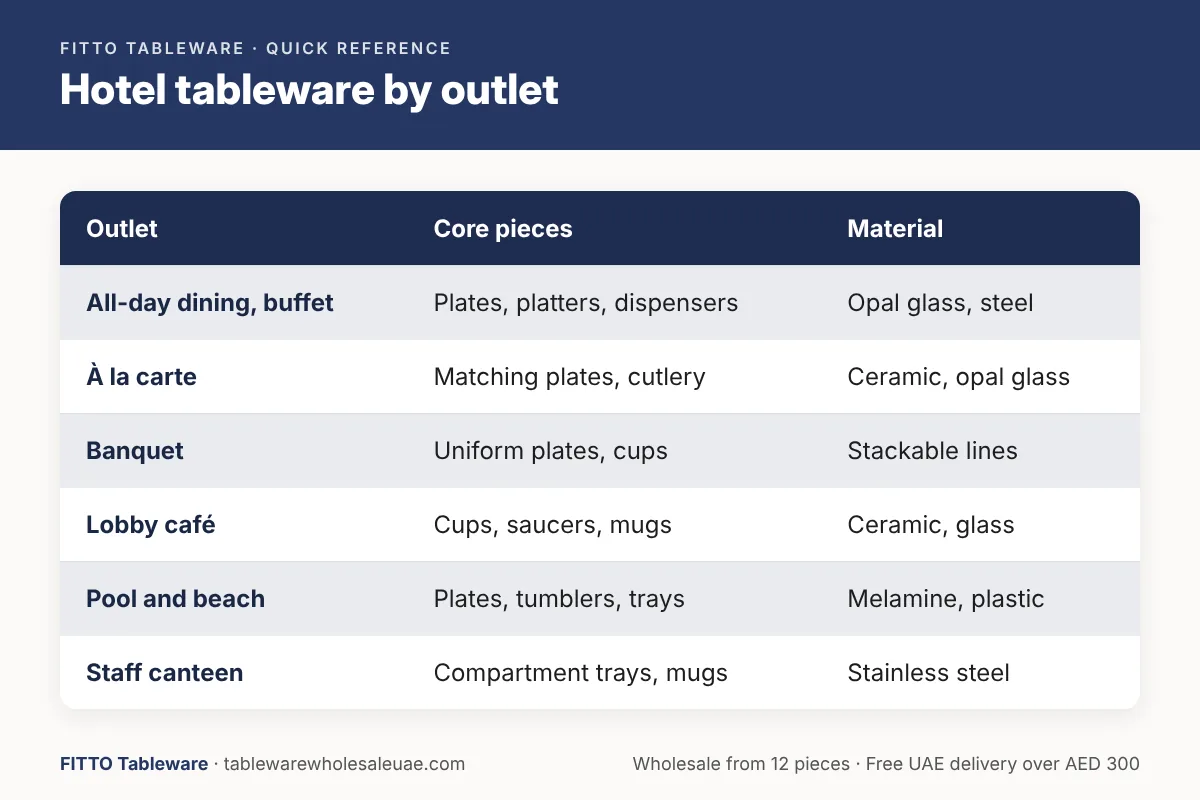
Each outlet has a different service style, so give each its own short list instead of one hotel-wide order. Buffets need serving capacity, à la carte needs consistency, and pools need pieces that cannot break.
| Outlet | Core pieces | Material priority | Watch out for |
|---|---|---|---|
| All-day dining and buffet | Dinner, side and soup plates; platters; dispensers; serving spoons | Opal glass or ceramic plates, steel and melamine serveware | Guests take a fresh plate each trip |
| À la carte restaurant | Matching dinner, starter and dessert plates; cutlery; glassware | Ceramic or opal glass, one design | Chips on rims show quickly |
| Banquet and ballroom | Large runs of identical plates, cups and saucers, cutlery | Stackable, uniform lines | Hundreds of covers set at once |
| Lobby lounge and café | Cups and saucers, mugs, dessert plates, small trays | Ceramic, opal glass, glass | Tea and coffee stains |
| Room service and in-room | Trays, cups, water glasses, small plates | Light, durable pieces | Weight on long corridors |
| Pool and beach | Plates, bowls, tumblers, trays | Melamine and plastic | Many pool decks do not allow glass |
| Staff canteen | Compartment trays, bowls, mugs, cutlery | Stainless steel, melamine | Volume and speed over looks |
Start the order with the outlet that has the most covers, usually the all-day dining room. Then check whether the same plates can serve the banquet team, which cuts the number of designs you need to stock.
Which materials suit hotel and restaurant use?
Use opal glass or ceramic where food is plated and carried carefully, and melamine or stainless steel where speed and drops are part of the job. No single material suits every outlet.
| Material | Strengths | Limits | Best outlets |
|---|---|---|---|
| Opal glass | Lighter than most ceramic, non-porous, resists stains | Can break if dropped on hard floors | Buffet, café, à la carte |
| Ceramic | Classic weight and finish, wide choice of shapes | Heavier; rims chip under rough handling | À la carte, banquet, lounge |
| Melamine | Hard to break, light, colourful patterns | Not for microwave or oven; knives can mark it | Pool, beach, kids' club, outdoor events |
| Stainless steel | Practically unbreakable, hygienic, long life | Shows water spots; can look institutional | Buffet serveware, staff canteen |
| Glass (tumblers, cups) | Clear, neutral look | Thin glass breaks in busy dishwashing | Restaurant, banquet, lounge |
Our guide to melamine vs opal glass plates compares the two most common plate materials. It explains where each one pays back in a busy service.
Plates and bowls
A standard main-course plate is 10 to 11 inches (about 26 to 28 cm). Side and dessert plates run 7 to 8.5 inches, and soup plates 8 to 9.5 inches. FITTO's 10.5 inch fluted opal glass dinner plate suits buffets and à la carte, while 10 inch melamine dinner plates (about 26 cm) suit outdoor outlets. Our full range of wholesale plates and bowls runs from small sauce bowls to 13 inch plates.
Cutlery, glassware and linen
Cutlery wears slowly but disappears fast, through bins, trays and room service. Our restaurant cutlery sets guide covers weight and steel grades. For glassware, choose plain tumblers in one size, such as 248 ml, so they stack and replace easily. Placemats in PVC, like a 38 x 38 cm gold-tone square mat, wipe clean between covers faster than cloth.
How do you equip a hotel buffet line?
Plan a buffet station by station, then give each station enough serving pieces for one full refill cycle. A dish being refilled in the kitchen still needs a replacement on the line.
- Map the stations: cold starters, salads, hot mains, carving, desserts, bread and drinks.
- Count the dishes at each station and add one spare platter or tray per two dishes for refills.
- Choose heat holding: chafing dishes for long hot lines, insulated hotpots for shared tables and iftar sharing.
- Add a dispenser for each drink, so staff are not pouring by hand at peak.
- Finish with serving spoons and tongs: two per dish, so one can be washed.
Large serving trays carry platters to the line and clear them away. A 24 inch melamine serving tray with dual handles (62 x 42 cm) is light enough to carry loaded, and it does not crack if it hits the pass. For bigger runs, white rectangular trays come in sizes up to 74 x 50 cm.
For drinks, a 5 litre glass beverage dispenser with stainless steel spigot holds water, juice or laban for a full sitting of a smaller buffet. Our comparison of insulated hotpots vs chafing dishes explains when each keeps food warm better. FITTO's serveware sets and dispensers cover the rest of the line.
How many pieces should you hold per seat or cover?
A common starting par is three of each plate per seat: one on the table, one in the dish area and one in storage. Buffets and busy cafés often need more, banquets less.
These are rules of thumb used across the trade. Adjust them after a month of real counts.
| Item | À la carte (per seat) | Buffet (per cover) | Banquet (per cover) |
|---|---|---|---|
| Dinner plates | 3 | 3 | 1.2 |
| Side and dessert plates | 3 | 3–4 | 1.2 |
| Soup plates or bowls | 2 | 2 | 1.1 |
| Each cutlery piece | 4 | 4 | 1.2 |
| Water glasses | 3 | 3 | 1.2 |
| Cups and saucers | 2 | 2–3 | 1.1 |
A 100-seat à la carte room would start with about 300 dinner plates and 400 dinner forks. A banquet hall setting 400 covers would hold about 480 dinner plates, because each course is set once and cleared, not turned during service.
Count stock at the same time each month and record breakage by outlet. Our guide to hotel tableware par levels shows how to turn those counts into reorder points.
How do you control breakage and replacement costs?
Standardise designs across outlets and reorder before stock falls below par, not after a busy weekend exposes the gap. Fewer designs mean fewer emergency orders.
Three habits cut most of the cost:
- Standardise. Use one plate design for all-day dining and banquets, and one tumbler size hotel-wide.
- Separate. Rack glasses and plates by type in the dish area; mixed racks cause most chips.
- Protect the pool and kids' club with melamine, where glass breakage also means closing an area to sweep.
Choose lines sold as open stock, meaning single plates, bowls and cups in trade packs, not only boxed sets. You can then replace 24 dinner plates without buying a new set of everything.
The UAE calendar matters too. Winter high season, Ramadan iftar and suhoor, Eid, New Year and the Dubai Shopping Festival all push covers up. Order replacement stock a few weeks before each peak, not during it.
What do caterers and restaurant groups need differently?
Caterers need tableware that travels, and restaurant groups need one specification that every branch can reorder. Both change what you buy.
A caterer's plates and serveware leave the building every weekend. Pieces are packed, driven across the emirates in summer heat, unpacked in a villa garden or a desert camp, then washed back at base. That favours:
- Stackable shapes that pack tightly in crates without wobbling.
- Melamine and stainless steel for outdoor events, where a dropped platter on sand or paving should not end the service.
- Insulated hotpots and drink dispensers that keep a family-style spread warm or cold without a power point.
- Spares of about 10% on every line, as a rule of thumb, because a missing plate on site cannot be fetched.
Restaurant groups face a different problem: drift. Each branch manager replaces broken pieces with whatever is nearby, and within a year no two branches match. Write a short specification sheet for each concept: plate sizes, cup capacities, cutlery pattern and the exact product codes. Every FITTO product page shows a product code, such as FT-800997 for the 10.5 inch opal plate, so branches can reorder the identical piece.
Central purchasing also lowers cost. One order for five branches reaches bigger pack sizes than five small orders.
What should you ask a hotel tableware supplier?
Ask whether the supplier can repeat the same lines for at least a year, in pack sizes that match your par levels. Price per piece matters less than the cost of a discontinued design.
Before you sign, check these points:
- Continuity. Will the same plate, cup and tray lines be available next season?
- Pack sizes. Can you buy in packs that match your par, rather than one fixed carton size?
- Mixed orders. Can one order combine different items and pack sizes for several outlets?
- Samples. Can you test one piece of each line in your dishwasher before the bulk order?
- Invoicing. Are prices shown with 5% VAT, and do you receive a proper tax invoice?
- Quality. What happens if pieces arrive damaged or do not match the sample?
At FITTO, mixed cartons, different pack sizes and regular supply are arranged through the quote form, and our returns and quality guarantee covers the last point.
FITTO Trade Pick: Outlet-ready tableware in trade packs Standardise on the 10.5 inch fluted opal glass dinner plate, opal glass coffee cups with saucers (190 ml) for the lounge and the 24 inch melamine tray for the line. Packs run from 12 to 144 pieces, and the 144-piece pack saves up to 20% per piece.

The bottom line
Equip a hotel or restaurant outlet by outlet, match each to the right material and set par levels of about three plates per seat. Standardise designs and buy from a supplier who can repeat the same lines, so breakage stays a routine reorder.
Browse the FITTO wholesale tableware range, request a quote for a multi-outlet order or order samples to test in your dish area. Sample costs are credited on a bulk order of AED 2,000+ within 30 days. Most orders are dispatched from Dubai within 2–3 working days, delivery is free over AED 300, and the trade desk is on WhatsApp +971 55 672 6947. FITTO Tableware: fit for the way you serve.
FAQ
What tableware material do most hotels use for buffets?+
Most hotel buffets combine ceramic or opal glass plates with stainless steel and melamine serveware. Plates need to look good and survive commercial dishwashers, while platters, trays and bowls on the line need to handle constant refilling. Melamine suits outdoor and themed buffets, and stainless steel suits hot mains and staff canteens.
How many plates does a 100-seat restaurant need?+
A common starting point is three dinner plates per seat, so about 300 for a 100-seat room. Add the same for side or dessert plates and about 200 soup plates or bowls. Busy cafés and buffets may need more. Count stock monthly for the first quarter, then adjust the par to your real breakage and turnover.
Is melamine acceptable for hotel buffets?+
Yes, melamine is widely used for buffets, pool service, kids' clubs and outdoor events. It is light, hard to break and comes in many patterns. Do not use it in microwaves or ovens, and serve hot food into it rather than heating food in it. Replace pieces once knife marks or stains build up.
How often should a hotel replace its tableware?+
There is no fixed cycle; replace by condition and by count. Remove chipped or cracked pieces at once, because they can harbour bacteria and cut guests. Many operators top up monthly against par and refresh a whole outlet's design every few years, often timed with a refurbishment or a new menu concept.
What size dinner plate do restaurants use?+
Most restaurants use a 10 to 11 inch (26 to 28 cm) dinner plate for mains. Fine dining may go larger for presentation, while cafés often use 9 inch plates for lighter dishes. Side and dessert plates are usually 7 to 8.5 inches, and soup plates 8 to 9.5 inches.