Restaurant cutlery sets: how to choose stainless steel cutlery that survives daily service
By FITTO Trade Desk · Last updated 29 October 2026
Restaurant cutlery sets should be stainless steel, ideally 18/10 or 18/8 for forks and spoons and hardened 13/0 for knife blades, heavy enough that pieces do not bend. Plan four core pieces per cover and stock three of each per cover, so one set is on the table, one in the wash and one in reserve.
Key takeaways
- Choose restaurant cutlery sets by steel grade, weight and finish, in that order.
- 18/10 and 18/8 steel resist spotting best; 18/0 costs less but needs prompt drying.
- Stock three of each core piece per cover and recount weekly.
- A magnet and a firm press on the fork tines tell you more than a product photo.
Guests notice a bent fork or a spotted spoon before they notice the food. Cheap flatware bends, spots and disappears into bins, and every emergency reorder costs time and money. This guide shows how to choose cutlery that still looks right after a year of service.
It is written for restaurant owners, hotel F&B managers and café operators across the UAE. At FITTO Tableware, a wholesale tableware supplier in the UAE, we stock cutlery and flatware (أدوات المائدة) from table knife sets to buffet serving spoons, and these are the checks we suggest before any bulk order.
What steel grade should restaurant cutlery be?
For forks and spoons, 18/10 or 18/8 stainless steel is the safe choice; for knife blades, 13/0 steel holds an edge better. The numbers show the percentage of chromium and nickel. More nickel gives better shine and resistance to spotting.
| Grade | Chromium / nickel | Spotting resistance | Magnetic | Best for |
|---|---|---|---|---|
| 18/10 | 18% / 10% | Highest | Generally no | Fine dining, hotels |
| 18/8 | 18% / 8% | High | Generally no | Busy restaurants, cafés |
| 18/0 | 18% / 0% | Moderate; dry promptly | Yes | Canteens, budget sets |
| 13/0 | 13% / 0% | Moderate | Yes | Knife blades |
A magnet is a quick check on a sample: 18/10 and 18/8 forks and spoons are generally non-magnetic, while 18/0 is magnetic. If a listing does not state the grade, test one sample before you order a full pack.
In a staff canteen with fast turnover, 18/0 is often good enough if pieces are dried straight after washing. With a hot commercial dishwasher, the extra nickel pays for itself.
How heavy should restaurant cutlery be?
Restaurant cutlery should feel solid in the hand and not flex when you press the fork tines on a plate. As a rule of thumb, forks and spoons around 2 mm thick hold their shape in daily service, while very thin pieces bend against a firm steak or a frozen dessert. Quick-service counters can use lighter cutlery that costs less to replace.
Which finish and handle style lasts longest?
A mirror or satin polish on plain stainless steel lasts longest; coloured and gold-tone finishes need gentler care. Mirror polish shows fingerprints but polishes back easily; satin (brushed) hides fine scratches better.
- Plain steel handles: easiest to wash and match on reorder. The default for restaurants and hotels.
- Coloured handles: useful for colour-coding, for example a staff set kept apart from guest cutlery.
- Gold-tone and decorative handles: for coffee, dessert and Arabic coffee or tea presentation. Wash gently to protect the finish.
How many pieces of cutlery does each cover need?
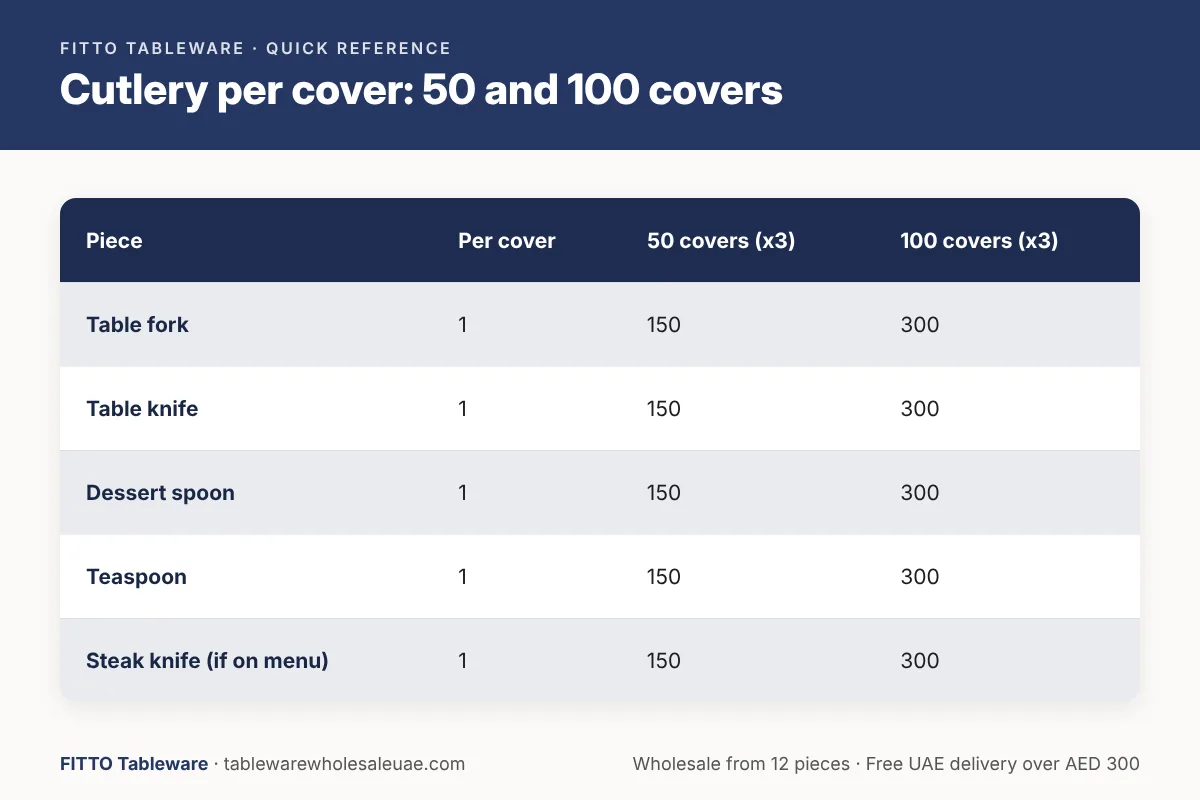
Plan four core pieces per cover: a table fork, a table knife, a dessert spoon and a teaspoon. Add steak knives or soup spoons only if your menu needs them. Then stock three of each per cover: one on the table, one in the wash and one in reserve.
| Piece | Per cover | 50 covers (x3) | 100 covers (x3) |
|---|---|---|---|
| Table fork | 1 | 150 | 300 |
| Table knife | 1 | 150 | 300 |
| Dessert spoon | 1 | 150 | 300 |
| Teaspoon | 1 | 150 | 300 |
| Steak knife (if on menu) | 1 | 150 | 300 |
Covers means seats; a café with a slow wash-up may need four per seat. For the full opening order, use our restaurant tableware checklist.
Which serving utensils does a buffet or sharing menu need?
Plan one serving spoon or fork per dish on the buffet, plus about 25% spare for swaps when one drops or gets sauced. Long handles matter: a 26 to 30 cm utensil reaches the bottom of a deep chafing dish or rice platter without the server's hand touching the food.
FITTO stocks stainless steel rice serving spoons in 23, 26 and 29 cm and a 30 cm serving fork. Use the 29 cm spoon for machboos and biryani platters and shorter sizes for sides.
How do you stop restaurant cutlery going missing?
Count it, contain it and catch it before it reaches the bin. Much missing cutlery is not stolen but scraped into the bin, sent out with deliveries or taken to the staff room.
- Count every piece type at close on the same day each week and log it.
- Scrape plates over a bin fitted with a mesh catcher.
- Keep staff cutlery in a different handle colour so it never mixes with guest sets.
- Use cutlery soaking bins at the wash station, not loose piles in the sink.
- Reorder when stock drops below two of each piece per cover.
How should restaurant cutlery be washed?
Pre-soak, wash, then dry and polish straight away. Spots and rust marks usually come from water, salt and detergent left on the steel, not from the steel itself.
Pre-soak to lift dried egg and sauces. Load cutlery heads up in the dishwasher basket so the eating ends get the full spray, then hand-dry or polish with a lint-free cloth while still warm, especially 18/0 steel. If your water leaves white marks, add rinse aid.
Should you buy cutlery sets or open stock?
Buy single-type packs for restaurants, and boxed mixed sets for gifting, retail and small venues. Single-type packs let you replace only the knives you lose; a boxed set suits a small café, a household shop or an Eid gift order.
Whichever route you take, stay with one pattern so reorders always match. Pair cutlery with matching crockery from our plates and bowls buyer's guide, and if you are opening a café, see where cutlery sits in our café tableware essentials.
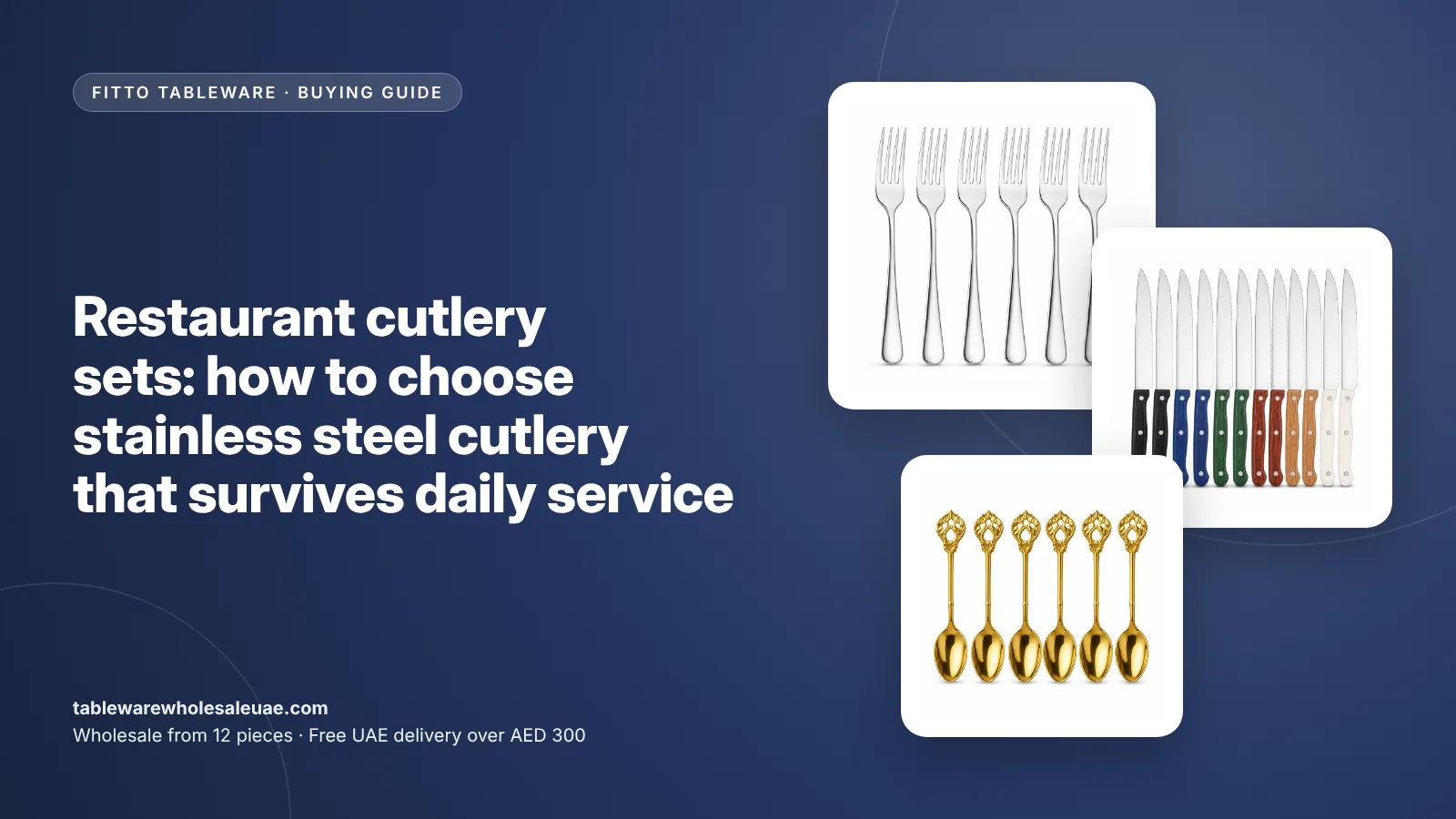
FITTO Trade Pick: Cutlery built for the wash, not just the table Use the 6-piece stainless steel table knife set for daily service, the 12-piece table knife set with coloured handles for colour-coded staff sets and gold-tone coffee spoons for coffee and dessert. Order a sample to test the weight and magnet check in hand; its cost is credited on a bulk order of AED 2,000+ within 30 days.
The bottom line
Good restaurant cutlery comes down to steel grade, weight and finish, then enough stock to cover the wash cycle. Choose one pattern, stock three of each piece per cover and count weekly, and your cutlery will still look right long after opening night.
Browse our wholesale cutlery and flatware, request a quote for a full opening order, or order a sample first. Packs run from 12 to 144 pieces and a boxed set counts as one piece; WhatsApp the trade desk on +971 55 672 6947. FITTO Tableware: fit for the way you serve.
FAQ
Is 18/0 stainless steel cutlery good enough for a restaurant?+
18/0 stainless steel works well for canteens, cafeterias and quick-service counters where cutlery is washed and dried promptly. It contains no nickel, so it can spot or show rust marks if left wet. For fine dining, hotels and venues with hot commercial dishwashers, 18/8 or 18/10 steel keeps its shine longer.
How many cutlery sets does a 40-seat restaurant need?+
Plan on three of each core piece per seat: one on the table, one in the wash and one in reserve. For 40 seats that is 120 table forks, 120 knives, 120 dessert spoons and 120 teaspoons. Add specialist pieces such as steak knives only for dishes on your menu, and recount weekly.
Can gold-tone cutlery go in the dishwasher?+
Gold-tone and coloured finishes last longer with gentle care, so check the care guidance on the listing, use a mild detergent and avoid abrasive pads. Many venues hand wash gold-tone coffee spoons and send plain stainless steel through the dishwasher.
Why does stainless steel cutlery get rust spots?+
Rust spots usually come from water, salt or detergent left on the steel, or from contact with other metals in the wash. Avoid long soaks in chlorine solutions and dry cutlery while warm; 18/0 steel needs the most care.
What is the difference between a dessert spoon and a tablespoon?+
A dessert spoon is the mid-sized spoon between a teaspoon and a tablespoon, used for desserts, cereal and soups served in shallow bowls. A tablespoon is larger and in many restaurants doubles as a serving spoon. In measuring terms, a dessert spoon is roughly 10 ml and a tablespoon 15 ml.