Plates and bowls wholesale: a complete buyer's guide for UAE restaurants, cafés and shops
By FITTO Trade Desk · Last updated 29 October 2026
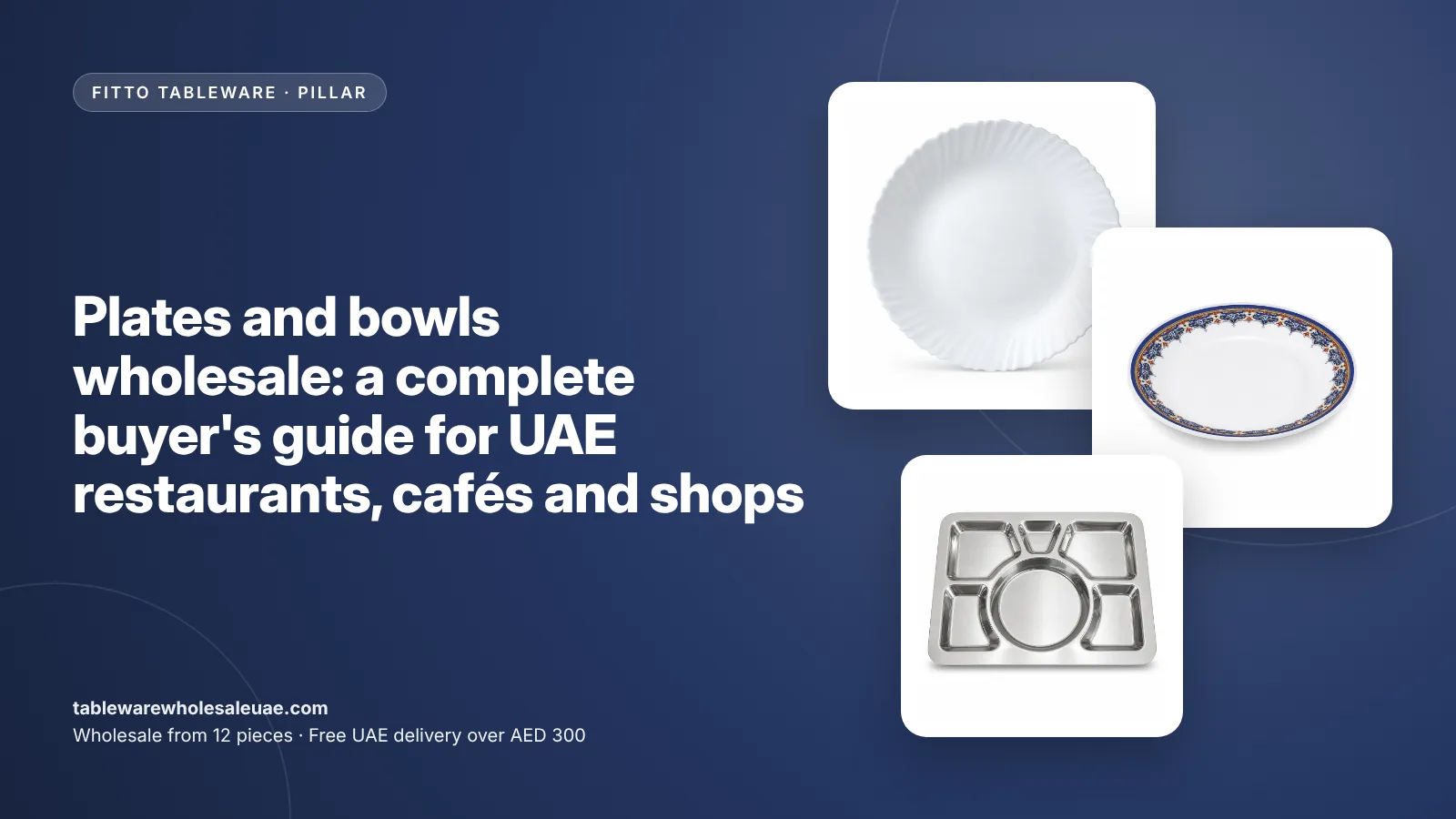
Buying plates and bowls wholesale in the UAE comes down to four decisions: material, sizes by course, quantity per cover and a quality check before the bulk order. Most restaurants and cafés need a 25–27 cm dinner plate, a 22–24 cm soup plate and two bowl sizes, ordered at two to three times the seat count.
Key takeaways
- Match the material to the service: melamine for speed and outdoor seating, opal glass for a clean white look, stainless steel for canteens and thali-style meals.
- Cover four sizes first: dinner plate, side or dessert plate, soup plate and a small bowl. Add specials only when the menu proves you need them.
- Order roughly two to three pieces per seat for each plate size, so you have stock on the table, in the dish pit and in reserve.
- Test one piece of any new line in your own dishwasher and on your own pass before you commit to a full order.
Chipped plates and mismatched bowls cost more than the replacement order. Guests notice, and every urgent top-up is bought in a hurry at a worse price. This guide settles what to buy, in which sizes and in what quantities, so your crockery (صحون) works for years, not months.
It is for restaurant and café owners, hotel purchasing teams and resellers across the emirates. At FITTO Tableware, a wholesale plates and bowls supplier in the UAE, our range is built mainly around opal glass, melamine and stainless steel, so the advice below compares materials we handle every day.
Which plate and bowl materials suit commercial service?
Four materials cover almost every commercial need: melamine, opal glass, ceramic and stainless steel. The right one depends on how fast your service runs, how much breakage you can absorb and whether food is reheated on the plate.
Melamine is a hard, lightweight plastic resin. It rarely breaks when dropped, which makes it the default for poolside service, kids' menus, food courts and outdoor terraces. The trade-off: it is not for the microwave or oven, and steak knives and strong spices can mark the surface over time.
Opal glass (often sold as opalware) is a white, glass-based material with a smooth, non-porous surface. It looks close to porcelain, resists staining from turmeric and tomato sauces, and is lighter than most stoneware. Tempered opal glass is generally microwave-safe, but heat ratings differ between makers, so check the product label before you promise it to your kitchen team.
Ceramic (porcelain and stoneware) feels the most traditional and holds heat well, but it is the heaviest option and chips most easily at the rim.
Stainless steel is close to unbreakable and very easy to sanitise. It suits staff canteens, labour accommodation kitchens, school kitchens, Indian and Pakistani restaurants serving thali meals, and any operation where noise and looks matter less than durability.
| Material | Breakage risk | Microwave | Weight | Best for |
|---|---|---|---|---|
| Melamine | Very low | No | Light | Terraces, food courts, kids' menus, buffets |
| Opal glass | Medium | Often yes (check label) | Medium | Cafés, family restaurants, hotel breakfast |
| Ceramic | Medium to high | Usually yes | Heavy | Fine dining, plated mains |
| Stainless steel | Almost none | No | Light to medium | Canteens, thali service, staff meals |
What plate sizes does a restaurant or café actually need?
Most venues run well on four plate sizes: a 25–27 cm dinner plate, a 19–22 cm side or dessert plate, a 22–24 cm soup plate and a 30 cm platter for sharing. Everything else is optional until your menu proves you need it.
Plate sizes in the UAE trade are usually listed in inches, so it helps to know the conversions. A 10-inch plate is about 25 cm, 10.5 inches is about 27 cm, 9.5 inches is about 24 cm and 12 inches is about 30 cm.
| Course or use | Typical size | Common inch label | Notes |
|---|---|---|---|
| Main course (dinner plate) | 25–27 cm | 10–10.5 inch | The workhorse; order the most of these |
| Large mains, grills, steak | 29–30 cm | 11.5–12 inch | Mixed grills and shawarma platters |
| Side, starter or dessert plate | 18–22 cm | 7–8.5 inch | Doubles as a bread or cake plate |
| Soup or pasta plate | 22–24 cm | 8.5–9.5 inch | Deep rim stops spills on the walk to the table |
| Sharing platter | 30–36 cm | 12–14 inch | Oval shapes suit mezze, fish and rice dishes |
The FITTO range follows the same ladder. Opal glass dinner plates come in 9.5, 10, 10.5 and 11.5 inch, with a 12-inch opal steak plate for grills. Dessert plates run from 7 to 8.5 inch, and soup plates from 7.5 to 10 inch.
In a café, the 7.5–8.5 inch plate does most of the work; in Arabic and Indian restaurants, soup plates and large platters matter more because dishes are shared.
Which bowl sizes should you stock?
Two bowl sizes cover most menus: a small 10–12 cm bowl for rice, dips and sauces, and a 17–19 cm bowl for salads, soups and noodles. A 23–25 cm serving bowl is the third size to add if you serve family-style.
Bowls are listed in inches too. A 4.5-inch rice bowl is about 11 cm, a 7-inch salad bowl is about 18 cm and a 9.5-inch serving bowl is about 24 cm.
- 3.5–4.5 inch (9–11 cm): rice, raita, hummus, sauces and sides.
- 5–6 inch (13–15 cm): soups, desserts, cereal and breakfast fruit.
- 7–8 inch (18–20 cm): salads, noodle dishes and individual mains.
- 9–10 inch (23–25 cm): shared salads, fattoush and rice for the table.
Melamine rice bowls in the FITTO range come in 3.5, 4, 4.5 and 5 inch, with matching salad bowls from 6 to 10 inch in the same patterns. Shops and online sellers do well with these ladders, because households tend to buy for the whole table at once.
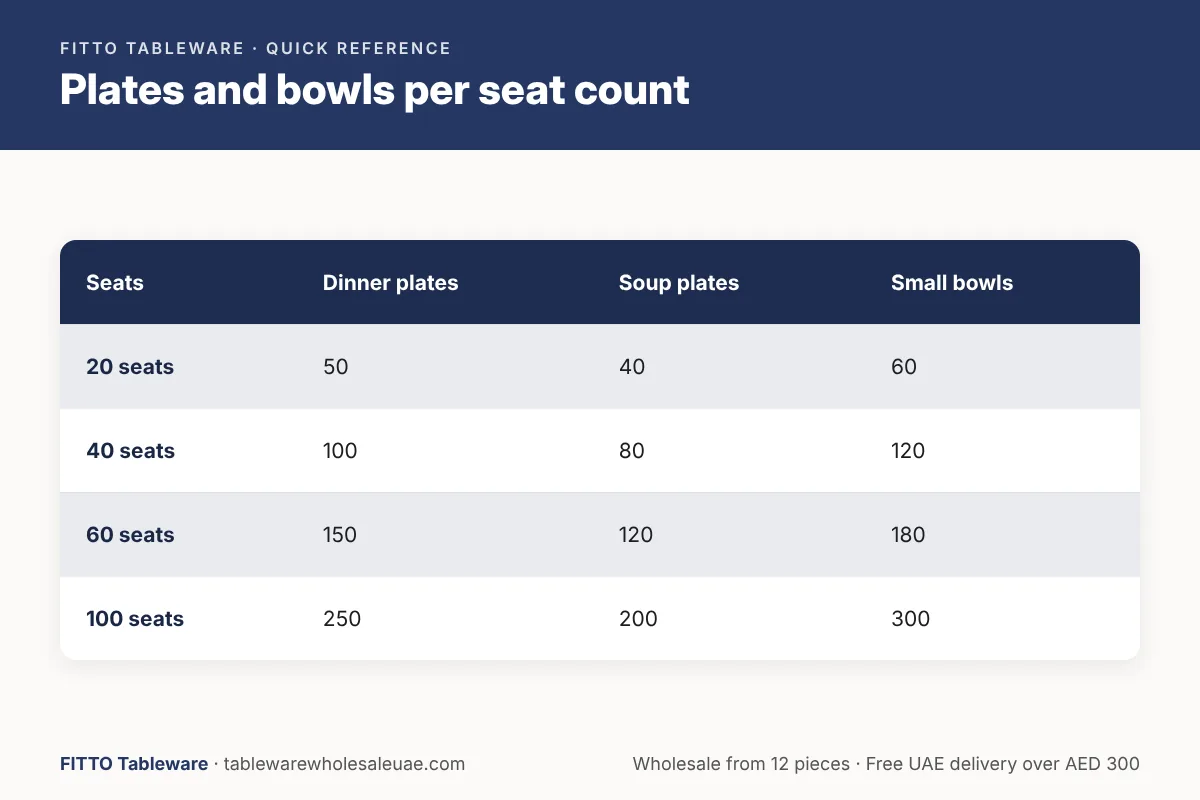
How many plates and bowls do you need per cover?
A common trade rule of thumb is two to three pieces of each plate size per seat. One set is on the table, one is in the dish pit and the rest is reserve for peak hours and breakage.
Fast-turning cafés can sit at the lower end; long dinner services, breakfast buffets and slow dishwasher cycles need the higher end.
| Seats | Dinner plates (×2.5) | Side plates (×2.5) | Soup plates (×2) | Small bowls (×3) |
|---|---|---|---|---|
| 20 | 50 | 50 | 40 | 60 |
| 40 | 100 | 100 | 80 | 120 |
| 60 | 150 | 150 | 120 | 180 |
| 100 | 250 | 250 | 200 | 300 |
These are starting points: count how many plates leave the kitchen in your busiest hour and adjust. Bowls often need a higher multiplier because they double as sauce and side dishes.
How do you turn a seat count into a plate and bowl order?
Work from the menu to the seat count, then round every line up to a full pack. Five steps keep the order tidy and stop you from buying sizes you will never use.
- List the dishes on your menu and note which plate or bowl each one leaves the kitchen on.
- Group them into your four core plate sizes and two or three bowl sizes, and pick the material for each.
- Multiply each size by your seat count and the per-cover factor from the table above.
- Round up to the nearest pack size shown on the product page, and compare the per-piece price at the next pack up.
- Keep 10–15% of each size in a separate reserve store, so breakage never leaves you short mid-service.
Plates rarely work alone. Our restaurant tableware checklist turns the same seat count into a full opening order, and our wholesale cutlery and flatware range finishes each cover.
Should a café choose melamine or opal glass plates?
For most cafés, opal glass gives the better look at the table, while melamine wins wherever plates travel far or get dropped. Many venues use both: opal glass inside, melamine on the terrace.
The full side-by-side comparison of breakage, heat, scratching and cost per year sits in our guide to melamine vs opal glass plates.
- Choose opal glass if food is reheated on the plate, if you want a bright white porcelain-style look, or if your dish pit is careful.
- Choose melamine if you serve outdoors, serve children, run a buffet or cater off-site.
- Choose stainless steel for staff meals and canteens where durability matters more than style.
Which plates and bowls suit Arabic, Indian and Asian menus?
Menus built on shared rice, stews and small sides need deeper plates, more small bowls and at least one large platter per table. A Western-style plate list will leave these kitchens short.
- Arabic and Emirati menus: deep soup plates of 9–10 inch suit harees, thareed and lentil soup, which is in heavy demand at iftar during Ramadan. Small 4–5 inch bowls carry hummus, mutabbal and pickles, and a 12–14 inch oval platter carries machboos or mixed grills for sharing.
- Indian and Pakistani menus: a stainless steel compartment thali plate holds rice, dal, curry and sides on one plate. Footed steel bowls of 9–12 cm work for dal and raita, and steel rice plates of 21–25 cm handle biryani portions.
- Asian menus: 4.5-inch rice bowls and 7–8 inch noodle bowls do most of the work, with small sauce bowls for dipping.
For the platters and trays that carry these shared dishes, see our serving trays and platters buyer's guide.
What do UAE shops and resellers stock in plates and bowls?
Resellers usually do best with coordinated ranges in one pattern across several sizes, so customers can build a full table set. Plain white is the steady, year-round line, while patterned pieces suit gifting seasons.
Households rarely buy one plate. They buy six or twelve of a size, plus matching bowls. That is why a patterned melamine range sold in dinner plate, soup plate, salad bowl and rice bowl sizes makes sensible shelf stock. As a retail rule of thumb, floral opal glass and printed melamine are worth building up before Ramadan, Eid and the October to April wedding season.
Online sellers should favour melamine and stainless steel, because breakage in transit leads to returns; opal glass travels well but needs more packaging.
How do you check plate quality before a bulk order?
Handle one piece of each line before you commit, and test it in your own kitchen for a week. Five quick checks catch most problems.
- Rim: run a finger round the edge. It should be smooth and even, with no rough glaze spots or seams.
- Flatness: spin the plate on a flat table. A plate that rocks will wobble under a knife and stack badly.
- Stacking: stack five pieces. They should sit straight without sliding or grinding against each other.
- Weight: compare it with your current plate; staff carry these all day.
- Washing: run the piece through your own dishwasher cycle several times and check for fading, marks or crazing.
How should plates and bowls be stored and handled in a UAE kitchen?
Store plates flat in moderate stacks, keep bowls nested by size, and never stack opal glass or ceramic while still hot from the dishwasher. Most chips happen in the dish pit and on the shelf, not at the table.
- As a rule of thumb, keep stacks to around 20–25 plates so the bottom pieces are not crushed or chipped.
- Let hot plates cool before stacking to avoid stress cracks.
- Keep melamine away from heat lamps, ovens and hot plate warmers.
- In summer, store spare stock in an air-conditioned storeroom rather than a hot back corridor or container.
- Check rims weekly and pull chipped pieces straight away. A chipped rim is a hygiene and safety risk.
FITTO Trade Pick: Build your core plate range in one order The opal glass dinner plate, 10.5 inch with fluted edge and opal glass soup plate, 9.5 inch suit indoor service, the melamine dinner plate, 10 inch white handles terraces and buffets, and the stainless steel compartment thali plate, 34 × 34 cm covers canteens. Every line comes in packs of 12 to 144 pieces, and the 144-piece pack costs up to 20% less per piece.

The bottom line
Pick the material by service style, stock four core plate sizes and two or three bowl sizes, and order two to three pieces per seat. Check one piece of every new line in your own kitchen before the bulk order, and keep a reserve so breakage never stops service.
Ready to plan your order? Browse our wholesale plates and bowls, request a quote for mixed cartons or regular supply, or order a sample at the single-piece price, credited against a bulk order of AED 2,000 or more within 30 days. Delivery is free across the UAE on orders over AED 300, and the Trade Desk answers on WhatsApp at +971 55 672 6947. FITTO Tableware: fit for the way you serve.
FAQ
Which plate size is standard for restaurants in the UAE?+
The standard dinner plate for most UAE restaurants is 25–27 cm, sold as 10 or 10.5 inch. Venues serving mixed grills, biryani or large platters often add an 11.5–12 inch plate. Cafés lean on 7.5–8.5 inch plates for cakes, pastries and breakfast items, with a 9–9.5 inch soup plate for pasta and soups.
Are melamine plates safe for restaurant use?+
Melamine plates are widely used in restaurants, food courts and hotel buffets because they are light and rarely break. Use them for serving food, not for heating it: keep melamine out of the microwave and oven, and away from heat lamps. Replace pieces that are deeply scratched or cracked, and follow the care guidance on each product label.
Is opal glass microwave safe?+
Tempered opal glass is generally suitable for the microwave. Heat ratings still differ between makers and lines, so check the label on the product you buy. Avoid sudden temperature shocks, such as moving a plate from a cold store straight into a hot oven.
How many plates should a 50-seat restaurant order?+
Using a common rule of thumb of two to three plates per seat, a 50-seat restaurant needs roughly 100–150 dinner plates, a similar number of side plates and about 100 soup plates. Add a 10–15% reserve for breakage. Adjust after counting how many plates leave the kitchen during your busiest service of the week.
What is the difference between a soup plate and a bowl?+
A soup plate is wide and shallow with a broad rim, usually 8.5–10 inch across, so it suits soups, pasta, harees and saucy mains that are eaten with a spoon and fork. A bowl is deeper and narrower, which keeps food hot for longer and suits rice, noodles, cereals and sides.
When should a restaurant replace its plates?+
Replace any plate with a chipped rim, a crack or crazing straight away, because damaged surfaces are hard to clean and can injure guests. Melamine should also be retired when it is deeply scratched or stained. A simple breakage log shows monthly losses so you can reorder before stock runs short.