Insulated hotpot vs chafing dish: which keeps buffet food warm better?
By FITTO Trade Desk · Last updated 29 October 2026
In the hotpot vs chafing dish choice, a chafing dish keeps buffet food warm better over long service, because a fuel burner heats it for two to six hours. An insulated hotpot only slows heat loss, but needs no fuel, flame or water. Choose hotpots for home meals and short buffets, chafing dishes for long events.
Key takeaways
- A chafing dish actively heats food over hot water; an insulated hotpot only holds the heat food already has.
- Hotpots suit family meals and buffets served within about two hours, with no running cost.
- Chafing dishes suit buffets of three hours or more, but need fuel, water, set-up time and care with open flames.
- A full-size chafing dish takes roughly the table space of three medium hotpots.
- Many hosts use both: chafing dishes for mains, hotpots for rice, bread and sides.
Lukewarm biryani is the complaint guests remember, yet chafing dishes and fuel for a 25-person family lunch can be overkill. This comparison settles which warmer to use, by heat time, fuel, cost, table space and event size.
It is for home hosts and small caterers in the UAE. At FITTO Tableware, a wholesale serveware supplier in the UAE, we stock insulated hotpots but not chafing dishes, so this is about which suits your event, not which we sell.
What is the difference between a hotpot and a chafing dish?
An insulated hotpot (حافظة طعام) is a lidded serving pot with an insulated body, while a chafing dish is a metal frame that holds a food pan over a pan of hot water heated by a burner. One holds heat; the other adds it.
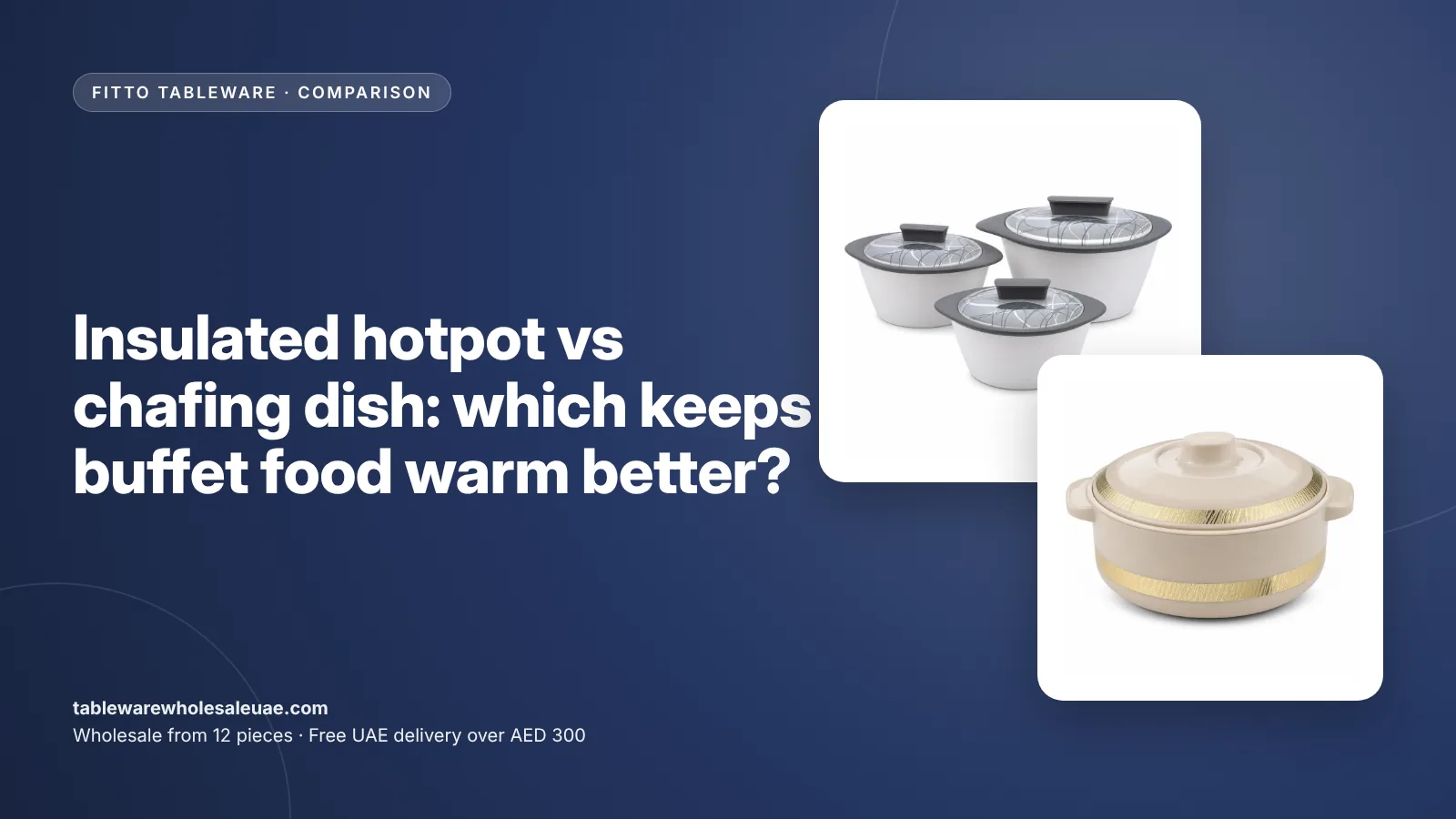
FITTO hotpots pair a plastic outer body with foam insulation and a fitted lid; food goes in from the stove and the pot goes to the table. A chafing dish has a stand, water pan, food pan and lid, with a fuel can or electric element heating the water, like a bain-marie. Full-size rectangular chafing dishes commonly hold about 8–9 litres of food.
Which keeps buffet food warm longer?
A chafing dish keeps food warm for as long as the fuel burns and the water pan is topped up, while a hotpot's food cools gradually from the moment the lid goes on. For anything beyond about two hours, a chafing dish wins.
Gel fuel cans typically burn for about two to two and a half hours, and wick fuel cans for about four to six hours, depending on the brand.
A well-filled, preheated hotpot keeps food pleasantly warm through a typical family meal or short buffet. How long it lasts depends on how hot the food goes in, how full the pot is and how often the lid is opened.
For food safety, common guidance is to keep hot food at about 60 °C or above, or to serve it within about two hours of cooking. A hotpot cannot guarantee 60 °C for hours, so serve and clear within that window. Neither warmer reheats cold food safely; both need food that is already piping hot.
How do hotpots and chafing dishes compare side by side?
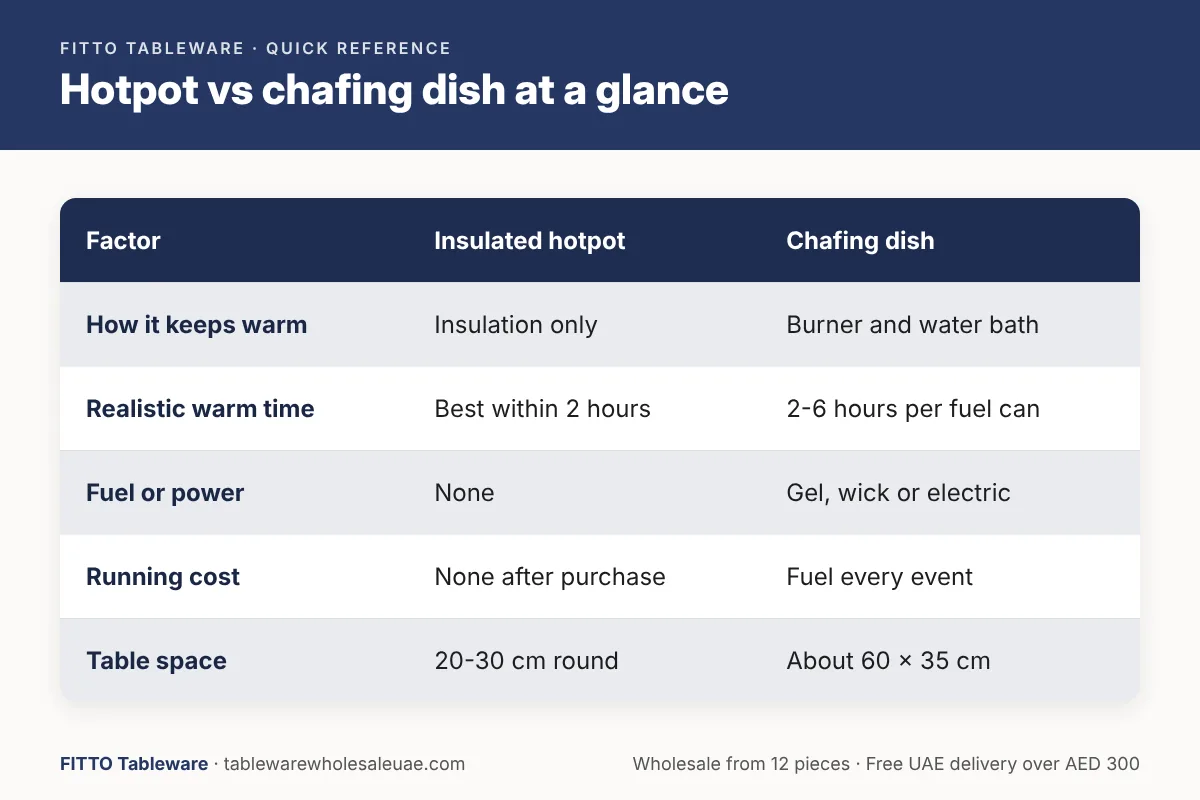
Hotpots win on cost, space, safety and simplicity; chafing dishes win on heat time and capacity.
| Factor | Insulated hotpot | Chafing dish |
|---|---|---|
| How it keeps food warm | Insulation slows heat loss | Burner heats a water bath |
| Realistic warm time | Best within about 2 hours | 2–6 hours per fuel can, longer with refills |
| Fuel or power | None | Gel or wick fuel cans, or electricity |
| Running cost | None after purchase | Fuel for every event |
| Capacity | 1,000–3,500 ml, plus large pots | About 8–9 litres (full size) |
| Table space | About 20–30 cm round | Roughly 60 × 35 cm |
| Set-up time | None: fill and close | Add hot water, light fuel, preheat |
| Safety | No flame | Open flame or hot element |
| Cleaning | Wash gently by hand; do not immerse | Several metal parts to wash |
| Look | Decorative, home-style | Professional buffet |
What does each cost to run?
A hotpot costs nothing to run once bought; a chafing dish adds fuel for every dish at every event. Six hot dishes over four hours may need one wick can or two gel cans each, so six to twelve cans per event, plus storage for frames and pans. A family hosting weekly in winter or Ramadan pays nothing extra for hotpots.
How much table space does each need?
A full-size chafing dish takes about 60 × 35 cm, roughly the space of three medium hotpots. A 1,500 ml hotpot is about 24 cm across, so it sits in the middle of a shared sufra or a narrow apartment counter. Chafing dishes need a straight buffet table with clearance around the flame.
Which should you choose for your event size?
Use hotpots for up to about 30 guests served within two hours, mix both for 30–80 guests, and use chafing dishes for long buffets or larger crowds. These are rules of thumb; service length matters more than guest count.
| Event | Best choice | Why |
|---|---|---|
| Family meal or iftar, up to 15 people | Hotpots | Food is eaten within an hour; no set-up |
| Home buffet, 15–30 guests, 2 hours | Hotpots, with refills from the stove | Low cost; refill hot from the kitchen |
| Party or majlis, 30–80 guests, 3+ hours | Chafing dishes for mains, hotpots for rice and bread | Long service needs active heat |
| Catered event, 80+ guests | Chafing dishes or electric warmers | Capacity and hours of hold time |
| Outdoor or desert-camp event | Hotpots, or electric warmers with power | Wind blows out burner flames |
For larger stock planning, our guide to catering serveware essentials lists hotpot quantities per 50 guests.
How do you keep buffet food warm in a hotpot?
Preheat the pot, fill it with piping-hot food, keep the lid closed and refill from the stove rather than leaving food out.
- Preheat the inside with hot water for a few minutes, then pour it out.
- Fill the pot well, straight from the stove; a full pot holds heat longer.
- Close the lid firmly until guests serve.
- Swap, do not top up: bring a fresh, hot pot from the kitchen rather than adding hot food to cooling food.
- Clear leftovers within about two hours and refrigerate them.
Our insulated hotpot buying guide covers sizes and sets in detail, and the serveware sets and dispensers guide shows how hotpots fit a full buffet.
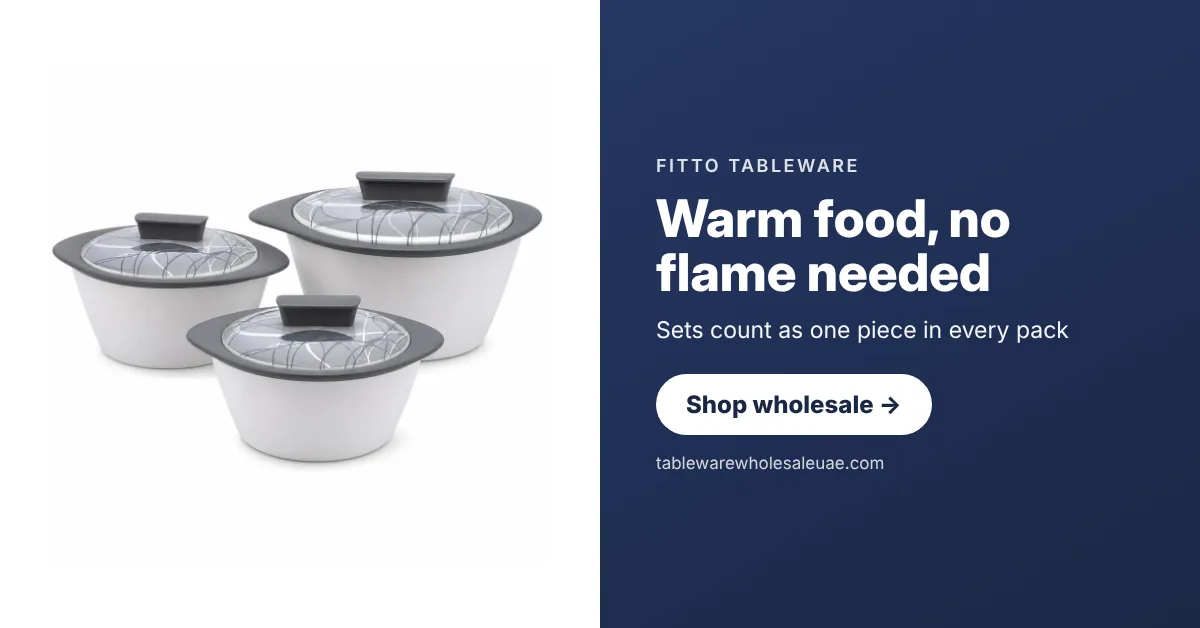
FITTO Trade Pick: Warm food, no flame, no fuel Set the table with the 3-piece insulated hotpot set, 1,500, 2,500 and 3,500 ml and add the large 30 × 26 × 16 cm hot pot for rice, with a 37 cm serving spoon for each pot. Packs start at 12 and sets count as one piece, so 12 sets give you 36 hotpots.
The bottom line
For long buffets, a chafing dish keeps food warm better because it adds heat. For family meals, majlis lunches and short home buffets, insulated hotpots do the job with no fuel, no flame and no running cost.
Browse our wholesale serveware sets and dispensers, request a quote for hotpot sets in mixed colours, or order a sample with its cost credited on a bulk order of AED 2,000+ within 30 days. Questions? WhatsApp +971 55 672 6947. FITTO Tableware: fit for the way you serve.
FAQ
How long does a hotpot keep food warm?+
It depends on how hot the food is, how full the pot is and how often the lid opens. A preheated, well-filled hotpot with the lid kept closed keeps food pleasantly warm through a typical meal. For food safety, plan to serve and clear hot food within about two hours of cooking.
How long does chafing dish fuel last?+
Gel fuel cans typically burn for about two to two and a half hours, and wick fuel cans for about four to six hours, depending on the brand and size. Check the burn time on the can, keep spares ready, and replace cans before they run out so the water bath stays hot.
Can I use a chafing dish without water?+
Most fuel-heated chafing dishes are designed to be used with water in the water pan. The water spreads heat evenly and stops food scorching on the bottom of the food pan. Running one dry can burn food and damage the pan, so follow the maker's instructions for each model.
Can I put a hotpot on the stove or in the oven?+
No. Insulated hotpots have a plastic outer body with foam insulation, so they must never go on a flame, hob or in an oven. Cook in a pot on the stove, then transfer the hot food into the hotpot to serve.
Are chafing dishes safe indoors?+
Fuel-heated chafing dishes use an open flame, so keep them away from curtains, paper decorations and children, and never leave them unattended. Check the venue's rules first, as some do not allow open flames. Electric chafing dishes avoid the flame but need a nearby power socket.