Hotel tableware procurement: how to set par levels and plan reorders
By FITTO Trade Desk · Last updated 29 October 2026
Set tableware par levels per outlet: multiply peak covers by the pieces each guest uses, then by a par multiplier, as a rule of thumb 3 for crockery and 4 for glassware and cutlery. Count every month, reorder any line that falls below about 80% of par, and round orders up to wholesale pack sizes.
Key takeaways
- Set par per outlet, not per hotel: all-day dining, banquets, in-room dining and the pool bar lose stock at different speeds.
- Par = peak covers × pieces per cover × par multiplier (rule of thumb: 3 for crockery, 4 for glassware and cutlery).
- Count on a fixed day each month and reorder any line below about 80% of par.
- Track loss as a percentage of par, so next year's budget comes from your own data.
- Keep to a short list of standard sizes, so top-ups match what is already in service.
A breakfast buffet that runs out of side plates at 8 am costs more than the plates: guests queue and someone raids the banquet store. Over-ordering hurts too, with cartons of glasses sitting in a storeroom. This guide settles how much tableware (أدوات المائدة) each outlet should hold, when to reorder and how to turn the numbers into supplier orders.
It is written for hotel purchasing managers, F&B managers and chief stewards. At FITTO Tableware, a wholesale tableware supplier in the UAE, we plan stock the same way, so the last sections show how par levels translate into pack sizes.
What is a tableware par level?
A par level is the quantity of each item an outlet needs to run a normal service between deliveries and wash cycles. It covers what is on the tables, what is in the dish area and what waits clean on the shelf.
Below par, service slows; far above par, cash sits in storerooms. One par sheet per outlet, reviewed every quarter, keeps both risks small.
How do you calculate tableware par levels for each outlet?
Multiply peak covers by the pieces each guest uses, then by a par multiplier. As a rule of thumb, use 3 for crockery and 4 for glassware and cutlery, because glasses break more often and cutlery disappears into trays and bins.
Use the busiest regular service, such as the weekend breakfast, not the average. "Per cover" is your own estimate: if half the guests take soup, use 0.5.
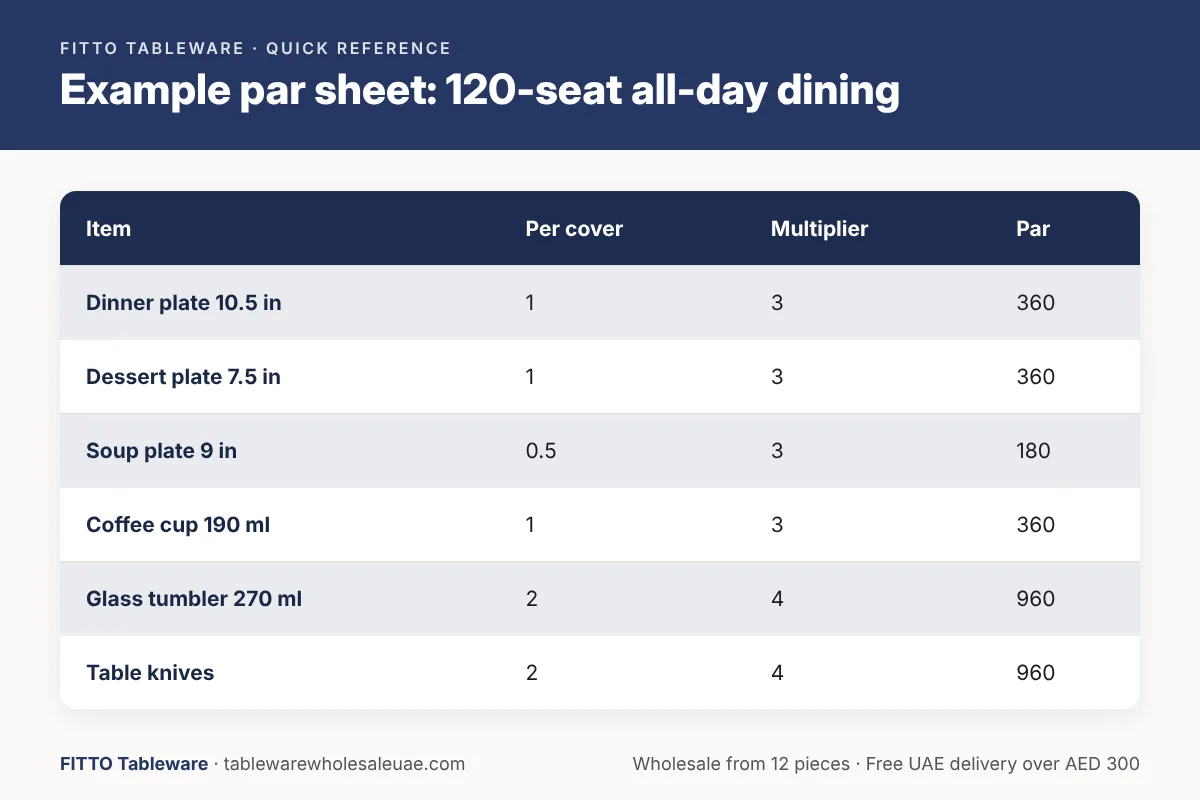
The example below uses sizes FITTO stocks in plates and bowls and glassware and cups. The figures are illustrative.
| Item (size) | Per cover | Multiplier | Par (pieces) |
|---|---|---|---|
| Opal glass dinner plate, 10.5 inch | 1 | 3 | 360 |
| Opal glass dessert plate, 7.5 inch | 1 | 3 | 360 |
| Opal glass soup plate, 9 inch | 0.5 | 3 | 180 |
| Opal glass coffee cup with saucer, 190 ml | 1 | 3 | 360 |
| Glass tumbler, 270 ml (water and juice) | 2 | 4 | 960 |
| Table knives | 2 | 4 | 960 |
| Forks and spoons | 2 each | 4 | 960 each |
Example: a 120-seat all-day dining outlet, one full turn at peak breakfast.
How should par levels differ between hotel outlets?
Each outlet loses and reuses tableware at a different speed, so each needs its own multiplier.
- All-day dining: the formula above, recalculated when seating or buffet layout changes.
- Banquets: size par to the largest event you regularly host, plus 10–15% spares for breakage and late table additions (a rule of thumb). If two events run back to back without a full wash, plan for both.
- In-room dining: count trays and cups, plus a float for trays that come back late.
- Pool and outdoor bars: many venues restrict glass near pools, so check your own safety policy and use non-glass tumblers there.
- Staff canteen: durable stainless steel, such as compartment mess trays, lasts far longer than glass and suits high-volume washing.
When should a hotel reorder tableware?
Reorder a line when the monthly count falls below about 80% of par, or earlier when a busy season is close. The 80% trigger is a rule of thumb; raise it for items with long lead times.
Use a simple quantity: order = par − stock on hand + expected loss until delivery. If dinner plates have a par of 360, the count shows 285 and you expect to lose 15 before the delivery, order 90.
Plan around the UAE calendar:
- October to April: peak season for many hotels; check pars before it starts.
- Ramadan: iftar buffets and suhoor tents add covers, so order four to six weeks before the month starts.
- Eid and New Year's Eve: confirm banquet stock a month ahead.
- June to August: quieter in many hotels, so run a full stocktake and retire chipped pieces.
How do you measure tableware breakage and loss?
Monthly loss rate = (opening count + deliveries − closing count) ÷ par. Example: plates opened at 350, 48 arrived and the closing count is 372, so 26 were lost, or 7.2% of a 360 par.
Split that figure into logged breakage, which points to handling and racking, and unexplained gaps, which point to trays left in corridors or cutlery thrown away with food waste.
Retire chipped plates and cracked glasses and count them as loss. There is no single "normal" breakage rate across hotels, so compare each outlet with its own last six months.
Cloudy glasses are a hidden loss too; our guide to fixing cloudy glasses from the dishwasher covers the usual causes.
How do you turn par levels into supplier orders?
Round each reorder up to the nearest wholesale pack and buy from a short list of standard designs. Every FITTO product comes in packs of 12 to 144 pieces, in steps of 12, 24, 48, 72 and 144. The price per piece falls as the pack grows.
Sets count as one piece: a pack of 12 six-piece tumbler sets gives you 72 glasses, so a 960-glass par needs about 160 sets.
For lead time, most orders leave Dubai within 2–3 working days and usually arrive 1–3 working days later. Mixed cartons are arranged on request, which helps when one count shows several lines below par. Our explainer on wholesale tableware pack sizes works through more examples.
Before committing to a new line, run one piece through your own dish machine for a week: your chemicals, water and racks are the real test.
For outlet opening lists, see the restaurant tableware checklist; for event stock, see catering tableware inventory.
FITTO Trade Pick: Core lines that are easy to top up For all-day dining pars, start with the 10.5-inch opal glass dinner plate, the 270 ml glass tumbler set of 6 and the 6-piece stainless steel table knife set. Test one of each in your dish machine first: the sample cost is credited on a bulk order of AED 2,000+ placed within 30 days.

The bottom line
Par levels work when they are set per outlet, counted monthly and tied to a reorder trigger. Use the formula, track loss against your own history and buy standard designs in pack sizes that match your gaps.
Browse the FITTO wholesale tableware range, send your par sheet through request a quote or order samples for a dish-machine test. Prefer to talk it through? WhatsApp the trade desk on +971 55 672 6947. FITTO Tableware: fit for the way you serve.
FAQ
What par level should a hotel use for glassware?+
As a rule of thumb, start glassware at 4 times peak use and adjust after three monthly counts. Bars and busy buffets may need 5. If an outlet never drops below 90% of par, you hold too much; if it keeps falling below 70%, raise the multiplier or fix the handling behind the loss.
How often should a hotel count its tableware?+
Count high-use outlets every month, on the same day and at the same point in service, so figures compare fairly. Count banquet stores after each large event, and run a full stocktake of every outlet once or twice a year in a quieter month.
Should banquet stock be kept separate from outlet stock?+
Yes. Banquet tableware should sit in its own locked store with its own par sheet, and anything lent to an outlet should be signed out and back. When stock moves freely, shortages appear in the wrong place and nobody can tell which outlet is losing items.
What is a normal tableware breakage rate for a hotel?+
There is no reliable single figure, because breakage depends on the menu, the dish area, staff turnover and how glass is racked. The useful benchmark is your own history: calculate each outlet's monthly loss rate, watch the trend and investigate any month that jumps well above the six-month average.
Can we top up several items in one mixed carton?+
Yes. Mixed cartons and different pack sizes can be arranged on request through the quote form, which suits a monthly count that shows several lines below par. List each item with its quantity and the trade desk confirms what can be combined.