Why glasses go cloudy in the dishwasher and how to fix it
By FITTO Trade Desk · Last updated 29 October 2026

Cloudy glasses from the dishwasher have one of two causes. A white film is mineral or detergent residue, and a vinegar soak removes it. Etching is permanent surface damage from heat and too much detergent, and nothing reverses it. Test with vinegar first, then fix salt, rinse aid, dose and temperature to prevent it.
Key takeaways
- Soak a cloudy glass in white vinegar for 15 minutes: if it clears, it was film; if not, it is etching.
- Film comes from hard-water minerals or leftover detergent, and it washes off with a mild acid.
- Etching comes from hot washes, strong detergent and overdosing, and it is permanent.
- Regeneration salt, rinse aid, the right detergent dose and a cooler glass programme prevent both.
Dull glasses make a clean table look neglected, and many households replace sets that only need a soak. This guide settles which problem you have, how to clear it and how to stop it coming back.
It is for restaurant staff and households across the UAE. At FITTO Tableware, a wholesale glassware supplier in the UAE, we want the glasses you buy to stay clear for years.
Why do glasses go cloudy in the dishwasher?
Glasses go cloudy either because something is left on the surface (film) or because the surface itself is worn (etching). The two look similar at first, but the fix is completely different.
Film is a thin layer of calcium and magnesium deposits from hard water (مياه عسرة), sometimes mixed with detergent residue. It builds up wash after wash, especially when the dishwasher's salt or rinse aid runs out.
Etching is tiny pitting and corrosion of the glass surface. Hot water and alkaline detergent slowly dissolve the surface, most of all when there is too much detergent and too little soil for it to work on. Soft water speeds this up.
Is it film or etching? The vinegar test
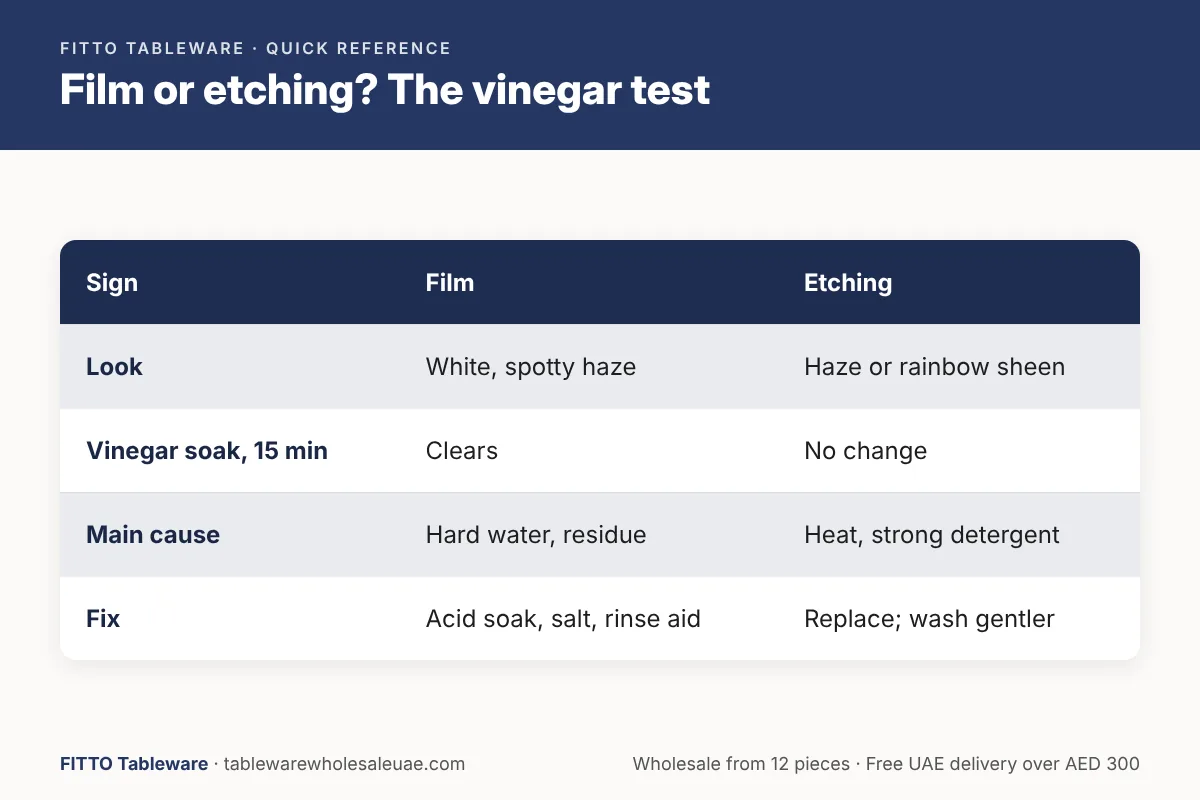
Soak one cloudy glass in white vinegar for about 15 minutes, rinse and dry it: if the cloudiness disappears, it is film; if it stays, it is etching.
| Sign | Mineral or detergent film | Etching |
|---|---|---|
| Look | White, milky or spotty haze | Milky haze, fine lines or rainbow sheen |
| Feel | Slightly rough or chalky | Smooth, or faint scratches |
| Vinegar test | Clears in about 15 minutes | No change |
| Main cause | Hard water, no salt or rinse aid, residue | Heat, strong detergent, overdosing |
| Can it be fixed? | Yes | No, only prevented |
Does UAE water cause cloudy glasses?
It can. Most UAE tap water is desalinated and remineralised before supply, and hardness varies by emirate, area and building tank. A white crust on your kettle, taps or shower glass is a reliable sign that your water leaves mineral deposits.
If your dishwasher has a built-in softener, a hardness test strip tells you which setting to use.
How do you remove cloudy film from glasses?
Soak the glasses in white vinegar, wipe them with a soft sponge, rinse in hot water and dry them with a lint-free cloth.
- Soak: fill a basin with warm water and white vinegar in equal parts, and soak the glasses for 15-30 minutes.
- Wipe: use a soft sponge inside and out. For stubborn rings, add a little bicarbonate of soda to the sponge.
- Rinse: rinse in hot, clean water to remove the vinegar.
- Dry: polish with a microfibre or lint-free cloth while the glass is still warm.
- Descale the machine: run a dishwasher cleaner or descaler through an empty cycle, following your manual. Some makers advise against vinegar in the machine because of the rubber seals.
A citric acid solution, about one to two tablespoons per litre of warm water, works the same way as vinegar with less smell. Never mix vinegar or acid cleaners with bleach. Skip long acid soaks on gold-rimmed or printed glasses; wipe these gently by hand instead.
How do you stop glasses going cloudy again?
Keep the softener salt and rinse aid topped up, use the right detergent dose for your water, and choose a cooler programme for glass.
- Salt: refill regeneration salt whenever the indicator lights up, and set the hardness level from a test strip.
- Rinse aid: water sheets off the glass instead of drying in mineral spots.
- Detergent: use less in soft water. All-in-one tablets suit average water; in very soft or very hard water, separate products give more control.
- Temperature: a glass or eco programme around 45-55 °C is gentler than an intensive wash at 65-70 °C.
- Loading: keep glasses apart so they do not knock or trap water, and do not place them over the heating element.
- Unload promptly: open the door at the end and let steam escape before glasses dry with drips on them.
Some glass sets are best kept out of the dishwasher altogether. The tall glass tumbler set and the heavy-base short tumbler set both recommend hand washing on their product pages, which keeps them clear for longer.
What should restaurants do about cloudy glasses?
Treat cloudiness as a machine and water problem first: descale the glasswasher, check the chemical dosing and use softened water where possible. Hand polishing hides film for a shift, but it returns by evening service.
Ask your chemical supplier to check dosing against your water hardness, descale on a schedule, and retire glasses that fail the vinegar test. Our restaurant drinking glasses guide covers glass shapes and par levels, and the glassware and cups wholesale guide compares tumbler and tea-glass ranges.
FITTO Trade Pick: Replace etched glasses for good If the vinegar test shows etching, swap in the tall 6.5 × 6.5 × 13 cm tumbler set or the heavy-base 8 × 8 × 9 cm tumbler set, and keep them clear with hand washing. Orders over AED 300 ship free across all seven emirates.

The bottom line
A vinegar test tells you in 15 minutes whether cloudy glasses can be saved. Film comes off with acid and stays off with salt, rinse aid and the right dose. Etching is permanent, so replace those glasses and wash the new ones more gently.
Browse our glassware and cups range, request a quote for replacement tumblers in volume, or order a sample with its cost credited on a bulk order of AED 2,000+ within 30 days. Questions? WhatsApp +971 55 672 6947. FITTO Tableware: fit for the way you serve.
FAQ
Can etched glasses be repaired?+
No. Etching is physical damage to the glass surface, so no cleaner, vinegar or polish reverses it. Some products hide light etching briefly by filling the scratches, but the haze returns after washing. The practical fix is to replace etched glasses and change the wash routine so the new ones last.
Is it safe to drink from cloudy glasses?+
Mineral film and light etching are cosmetic problems, and the glasses can still be used. The bigger concern is hygiene: film can trap residue, so clear it with a vinegar soak. Replace any glass that is chipped or cracked, as damaged rims can cut lips and fingers.
Why are only some of my glasses cloudy?+
Different glasses react differently to the same wash. Thinner or older glass etches faster, and glasses on the bottom rack or near the heating element get more heat. Crystal and decorated glasses are usually more sensitive than plain everyday tumblers, so wash them by hand.
How do I get the cloudy look off tea glasses?+
Small tea and karak glasses cloud the same way, often with tea tannin on top. Soak them in warm water and vinegar for 15 minutes, then wipe with bicarbonate of soda on a soft sponge. Our guide to karak tea glasses covers sizes and care.