Drinking glasses for restaurants: how to choose tumblers that survive service
By FITTO Trade Desk · Last updated 29 October 2026
The best restaurant drinking glasses are plain, sturdy tumblers sized to the drink: 230-270 ml for water, around 210 ml for juice and 350-400 ml for iced drinks. Choose thick rims and heavy bases, stock about three water glasses per seat, store them dry and racked, and check each product's care note before machine washing.
Key takeaways
- Match capacity to the drink: 230-270 ml for water, about 210 ml for juice, 350-400 ml for iced drinks and mocktails.
- Thick rims and heavy bases survive knocks better than thin, delicate glass; the rim chips first.
- Plan roughly three water glasses per seat and keep 10-15% extra in the storeroom (rule of thumb).
- Stackable glasses save shelf space, but only stack them dry and not too high.
- Read the care note on every listing: some glass sets are marked for hand washing only.
A chipped rim sends a glass to the bin, and a cracked one can send a guest home unhappy. Replacing glasses every few weeks quietly eats into margins, especially in a busy Dubai or Abu Dhabi dining room where water is poured all service. This guide settles which tumbler shapes, sizes and quantities stand up to restaurant work.
It is written for restaurant and café managers buying or replacing glassware. At FITTO Tableware, a wholesale glassware supplier in the UAE, we sell tumbler sets by the pack, so the advice below is about choosing well, not buying more.
What size of restaurant drinking glasses do you need?
Pick capacity by drink, not by looks: about 230-270 ml for water, around 210 ml for juice and soft drinks without ice, and 350-400 ml for anything served over ice.
In the UAE heat, guests drink more water, and iced drinks need room for ice. A 400 ml tumbler leaves space for a scoop of ice and a full serve of lemon mint. Smaller 210 ml glasses keep fresh juice portions consistent, which helps food costing.
| Drink | Typical capacity | FITTO tumbler that fits |
|---|---|---|
| Water with meals | 230-270 ml | 230 ml faceted tumbler set or 270 ml flared tumbler set |
| Fresh juice, soft drinks without ice | 200-250 ml | 210 ml straight tumbler set |
| Iced drinks, mocktails, lemon mint | 350-400 ml | 400 ml embossed tumbler set, 8 × 8 × 11 cm |
| Laban, short pours, kids' drinks | Short tumbler | Heavy-base short tumbler set, 8 × 8 × 9 cm |
Keep to two or three glass types across the menu. Fewer types mean simpler racks, faster polishing and easier reordering.
Which tumbler shape survives restaurant service best?
Straight or gently tapered tumblers (أكواب) with a thick rim and a heavy base last longest, because there is no stem to snap and the base absorbs knocks. Stemmed glasses look smart but break more easily when cleared in a hurry.
Most breakage happens at the rim, either against a tap at the sink or against another glass in a rack. A thicker rim spreads that impact. A heavy base lowers the centre of gravity, so a glass knocked by an elbow is less likely to topple.
Short tumblers are the hardest-wearing shape for family restaurants and cafés with children. Tall, narrow glasses are elegant for juice but tip more easily on crowded tables.
Should restaurant glasses be tempered?
Tempered glass is a sensible upgrade for very high-volume service, but it is not essential for most cafés and family restaurants. Fully tempered tumblers are heat-treated to resist impact and break into small, blunt pieces rather than sharp shards.
If a product listing does not state "tempered", treat the glass as standard glass. That means letting it cool before adding ice, keeping it away from hard knocks and replacing any chipped piece straight away. For many operators, a heavy-base standard tumbler handled well gives a lower cost per year than a premium tempered range.
How do dishwashers affect glass life?
Hot water and strong detergent wear glass over hundreds of cycles, which shows up as cloudiness and weaker rims. Several FITTO glass tumbler sets recommend hand washing, so check the care note on each product page before choosing a machine-washed range.
If you use a glasswasher, follow these habits:
- Use glass racks, never loose glasses on a plate rack. Rack size matters: a 36-compartment rack typically suits glasses up to about 75 mm across, and a 25-compartment rack glasses up to about 90 mm (check your rack maker's specification).
- Dose detergent and rinse aid correctly; overdosing speeds up etching.
- Let glasses cool for 10-15 minutes before adding ice. A sudden jump from hot to ice-cold can crack glass.
- Inspect rims at polishing and remove any chipped glass from service.
With 8 cm-wide tumblers, plan on 25-compartment racks; slimmer 6.5 cm tumblers fit 36-compartment racks.
Are stackable glasses worth it?
Yes, for tight storage, as long as staff stack them only when dry and keep stacks short. Nested glasses take the floor space of one glass, which helps in small café back areas and on bar shelves.
The clear stackable drinking glasses set uses a tapered profile so matching glasses nest together. Wet glasses can create suction and wedge together, and forcing them apart chips rims. Non-stackable straight tumblers are better stored upside down in racks, which also keeps dust out.
How many glasses does a restaurant need per seat?
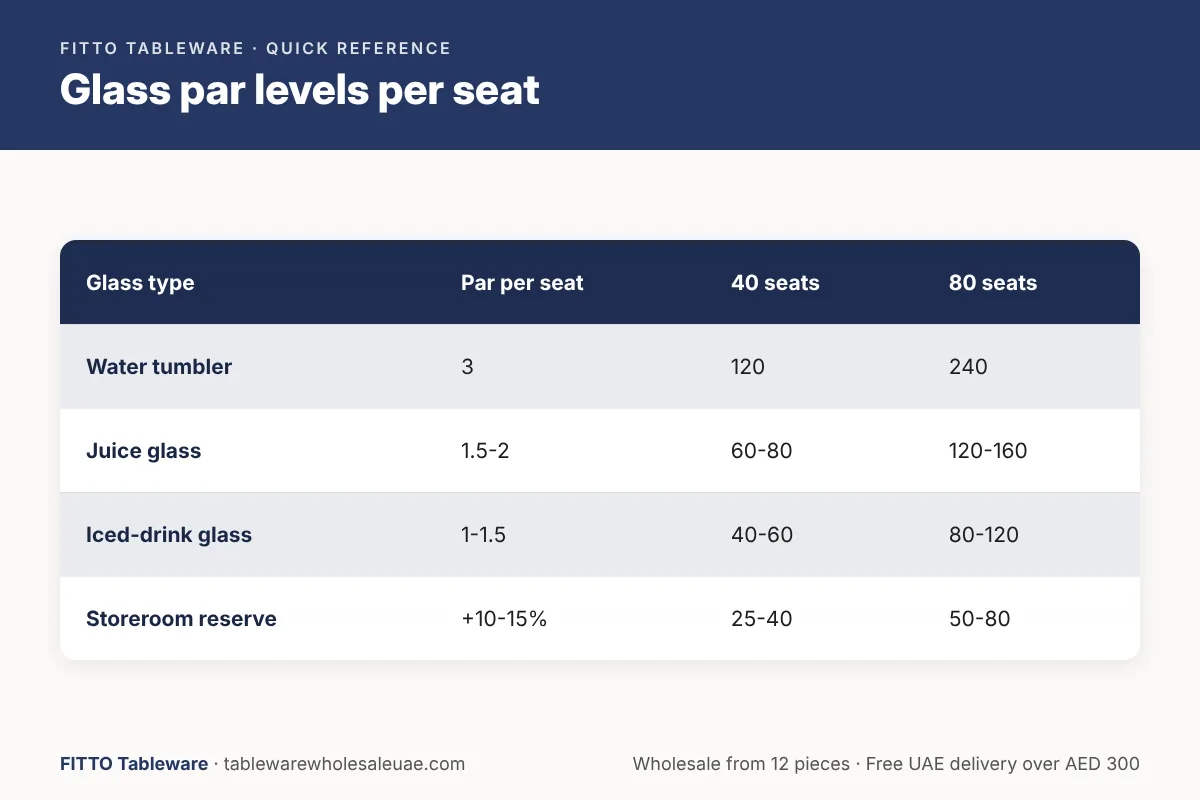
As a rule of thumb, stock about three water glasses per seat: one on the table, one in the wash cycle and one in reserve. Add 10-15% extra in the storeroom to cover breakage between orders.
| Glass type | Par per seat (rule of thumb) | 40-seat café | 80-seat restaurant |
|---|---|---|---|
| Water tumbler | 3 | 120 | 240 |
| Juice and soft-drink glass | 1.5-2 | 60-80 | 120-160 |
| Large iced-drink glass | 1-1.5 | 40-60 | 80-120 |
| Storeroom reserve | +10-15% of total | 25-40 | 50-80 |
Raise the numbers for fast table turns, outdoor terraces or venues that wash in batches. Track breakage monthly; if you replace more than your reserve each month, look at rack habits before buying more glass.
Our glassware and cups wholesale guide covers tea glasses and cups, and the restaurant tableware checklist puts glassware alongside plates and cutlery. For opening budgets, see our café tableware essentials for Dubai.
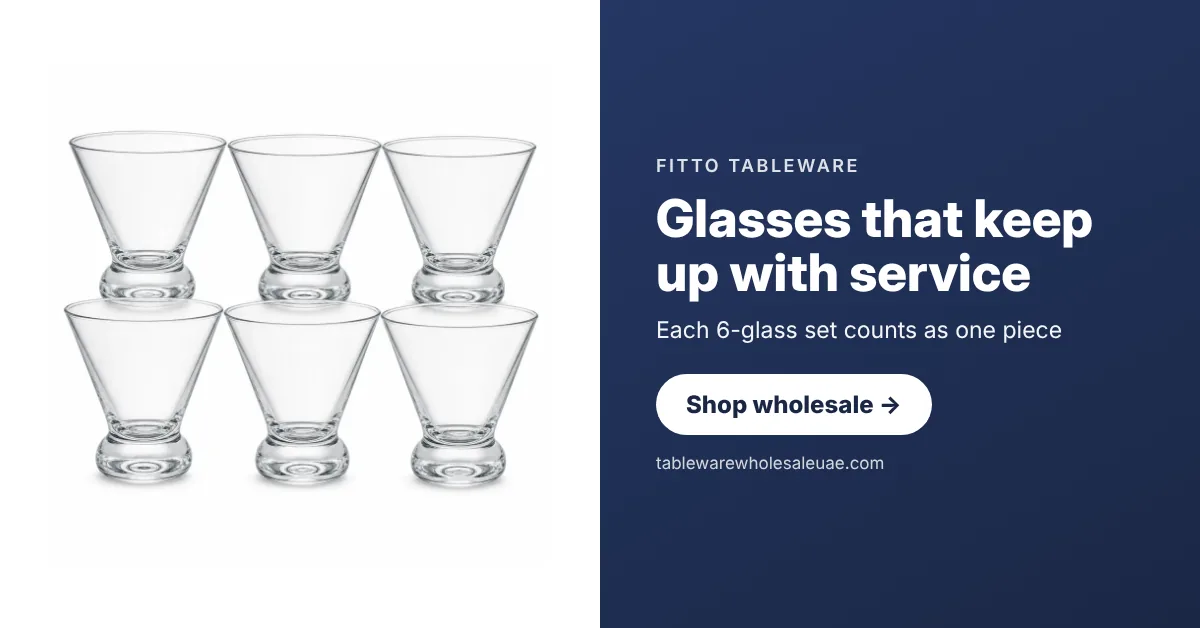
FITTO Trade Pick: Glasses that keep up with service Pair the 270 ml flared tumbler set for water with the 400 ml embossed tumbler set for iced drinks. Each 6-glass set counts as one piece and packs start at 12, so a pack of 12 sets gives you 72 glasses.
The bottom line
Restaurant drinking glasses should be chosen by drink size, rim strength and how you wash them, not by looks alone. Keep the range small, stock about three water glasses per seat and remove chipped glasses at once.
Browse our glassware and cups range, request a quote for tumblers by the carton, or order a sample to test in your own glasswasher, with its cost credited on a bulk order of AED 2,000+ within 30 days. Questions? WhatsApp +971 55 672 6947. FITTO Tableware: fit for the way you serve.
FAQ
What is the standard size of a restaurant water glass?+
Most restaurants use water tumblers of about 230-300 ml. That size holds a full pour with a little ice and fits standard glass racks. Larger 350-400 ml glasses suit iced drinks and hot-weather terraces, but they take more shelf space and need refilling less often, so staff visit the table less.
Why do restaurant glasses crack for no obvious reason?+
Usually it is thermal shock or a hidden chip. Glass that goes straight from a hot washer to ice water expands and contracts unevenly and can crack. A small rim chip from an earlier knock also weakens the glass. Let glasses cool before adding ice and check rims during polishing.
Are plastic tumblers better than glass for restaurants?+
Plastic tumblers suit poolside areas, outdoor terraces and kids' menus, where breakage is a safety risk. Glass looks cleaner, does not scratch as easily and feels better to most diners. Many UAE venues use glass indoors and plastic or stainless steel outside, keeping the two ranges separate.
How long do restaurant glasses last?+
There is no fixed lifespan; it depends on handling, washing and storage. Glasses lost to breakage usually go long before wear-out. Glasses that stay in service gradually cloud from detergent and hot water. Tracking breakage monthly shows whether you need stronger glass or better rack and stacking habits.
Can I put ice in glasses straight from the dishwasher?+
It is best not to. A glass just out of a hot wash cycle can crack if filled with ice water immediately. Let it cool for 10-15 minutes, or rotate stock so the glasses going to tables have already cooled on the shelf.