Why cutlery gets rust spots and how to prevent them
By FITTO Trade Desk · Last updated 29 October 2026
Cutlery rust spots appear when the thin protective layer on stainless steel is broken down by salt, acidic food, long soaking or contact with other metals. Most spots come off with a baking soda paste or a short vinegar soak. Prevent them by rinsing soon after meals, never soaking overnight, unloading the dishwasher promptly and drying everything before storing.
Key takeaways
- Stainless steel resists rust but is not rust-proof; salt, acid and standing water are its main enemies.
- Many orange spots are "transfer rust" from other items in the dishwasher, not from the cutlery itself.
- Knives spot first because their blades use a harder steel with less corrosion resistance.
- Remove light spots with baking soda paste, stubborn ones with a short vinegar soak, then rinse and dry.
- Never use steel wool or bleach, and keep silver-plated pieces away from stainless steel in the wash.
Rust spots make clean cutlery look dirty, and in a restaurant a spotted fork can end up on a guest's table.
This guide explains why spots form, how to remove them safely and how to stop them coming back. It is for restaurant staff, stewards and households. At FITTO Tableware, a wholesale tableware supplier in the UAE, we supply stainless steel cutlery to homes and food businesses.
Why does stainless steel cutlery get rust spots?
Stainless steel stays shiny because its chromium forms an invisible protective film on the surface; rust (صدأ) appears wherever that film is damaged faster than it can re-form. The film needs oxygen and a clean surface to repair itself.
The common causes are:
- Salt and acidic food left to dry: salty sauces, lemon, tomato and vinegar attack the surface, especially overnight.
- Long soaking: cutlery left in a sink or bucket for hours sits in low-oxygen, often salty water.
- Dishwasher salt: spilled granules from refilling the softener, or a loose salt cap, put concentrated salt on the load.
- Mixed metals: silver-plated or aluminium items washed with stainless steel can set up a reaction that marks both.
- Transfer rust: particles from rusty racks, cast-iron pans or steel wool settle on cutlery and rust there.
- Damp storage: in humid summers, cutlery put away wet stays wet in a closed drawer.
Why do knives rust before forks and spoons?
Table knife blades are usually made from a harder, lower-chromium steel so they can hold an edge, and that steel resists corrosion less well. Forks and spoons are often made from a more corrosion-resistant grade.
That is why spots usually show first on the blade. Our guide to 18/10 vs 18/0 cutlery explains what the numbers mean.
Is it rust or something else?
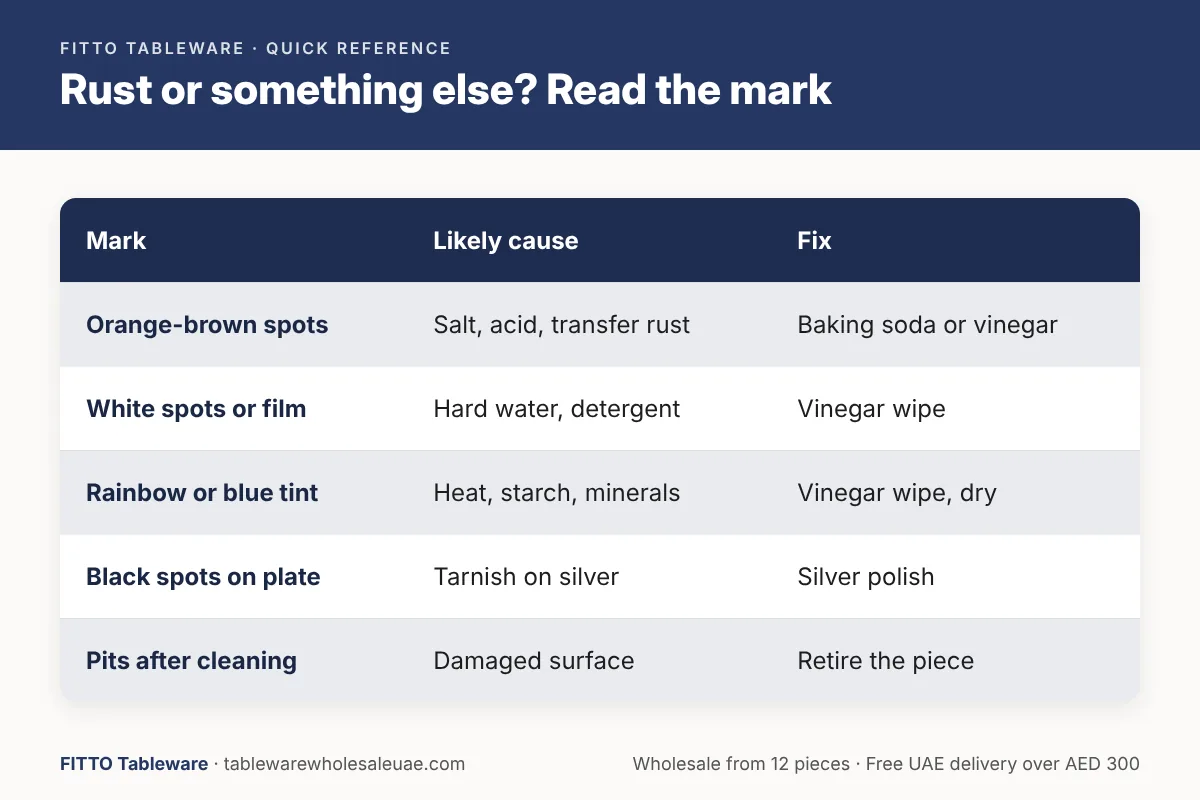
Orange or brown spots are rust; white spots are usually limescale or detergent; rainbow tints are usually heat or starch marks. Identify the mark first.
| Mark | Likely cause | How to fix it |
|---|---|---|
| Small orange-brown spots | Salt, acid or transfer rust | Baking soda paste or short vinegar soak |
| White spots or film | Hard water, too much detergent | Vinegar wipe; check detergent dose |
| Rainbow or blue tint | Heat, starch or minerals | Vinegar wipe, then rinse and dry |
| Black spots on silver plate | Tarnish, not rust | Silver polish; wash separately |
| Small pits that stay after cleaning | Surface already damaged | Retire the piece from service |
How do you remove rust spots from cutlery?
Clean light spots with a baking soda paste and stubborn ones with a short vinegar soak, then rinse and dry at once. Work gently to avoid scratching the polish.
- Wash the cutlery in warm soapy water to remove grease.
- Rub light spots with a paste of baking soda and a little water, using a soft cloth and following the polish lines.
- Soak stubborn spots for 5–10 minutes in warm white vinegar, or use a cleaner sold for stainless steel.
- Rinse thoroughly in clean water, so no acid stays on the surface.
- Dry each piece straight away with a soft, lint-free cloth.
- Check under good light; repeat once if needed, then retire any piece that still shows pits.
Never use steel wool or bleach: steel wool leaves iron particles that rust, and bleach attacks stainless steel.
How do you stop cutlery rusting in the dishwasher?
Load it straight after the meal, run the cycle promptly and unload as soon as it finishes. Most dishwasher rust comes from cutlery sitting wet in a warm, steamy machine.
- Rinse off salty or acidic food before loading.
- Wipe up spilled dishwasher salt and check that the salt cap is tight before each cycle.
- Use the detergent dose on the pack, not more.
- Wash silver-plated and gold-tone pieces separately or by hand, following the product's own care guidance.
- Keep rusty racks, cast-iron pans and old baking trays out of the same load.
- Open the door at the end and dry cutlery once it is cool.
How should restaurants handle cutlery to prevent spots?
Keep pre-soaks short, wash soon and polish dry before storing. A cutlery cylinder that sits in pre-soak solution through a long service is a common cause of spotting.
Change the pre-soak water regularly and never leave cutlery in it after closing. After washing, polish with a dry lint-free cloth, handling pieces by the handle, and store them in dry caddies.
For buying and setting up service cutlery, see our restaurant cutlery sets guide and the wider cutlery and flatware trade guide.
How should you store cutlery at home?
Store cutlery only when it is completely dry, in a drawer or caddy with some airflow. Damp cutlery packed into a closed drawer creates exactly the conditions rust needs.
Keep knives in their own slot so blades do not rub against other pieces.
FITTO Trade Pick: Cutlery that is easy to keep spotless The 8-piece stainless steel cutlery set in a display tray and the 6-piece stainless steel table knife set suit homes and dining rooms; add gold-tone coffee spoons for tea service. Orders over AED 300 are delivered free to all seven emirates.

The bottom line
Rust spots on stainless cutlery come from salt, acid, soaking, mixed metals and damp storage. Clean them gently, rinse and dry, and the same habits will stop most spots returning.
Browse the cutlery and flatware range, send your list through request a quote or order samples to test cutlery in your own dishwasher. Questions? WhatsApp the trade desk on +971 55 672 6947. FITTO Tableware: fit for the way you serve.
FAQ
Is it safe to use cutlery with rust spots?+
Clean it before using it again. Rust flakes do not belong in food, and a spotted surface is harder to keep hygienic. Light spots usually come off with baking soda or vinegar. If small pits remain after cleaning, retire the piece, especially in a restaurant.
Does 18/10 stainless steel cutlery never rust?+
It resists rust better than most cutlery steels, thanks to its chromium and nickel, but no stainless steel is fully rust-proof. Left soaking overnight or washed beside rusty pans, 18/10 cutlery can still spot. Washing and drying habits matter as much as the grade.
Can I wash silver-plated and stainless steel cutlery together?+
It is better not to. When silver-plated and stainless steel pieces touch in a wet dishwasher basket, a reaction between the metals can mark both. Wash silver-plated pieces separately, ideally by hand, and dry them straight away.
Does dishwasher salt cause rust spots on cutlery?+
Spilled dishwasher salt can. The salt belongs in the softener compartment; spilled granules or a loose cap put concentrated salt onto the load. Refill it when the basket is empty, wipe up spills and check that the cap is tight.