Cutlery and flatware: a complete trade guide to steel, weight and sets
By FITTO Trade Desk · Last updated 29 October 2026
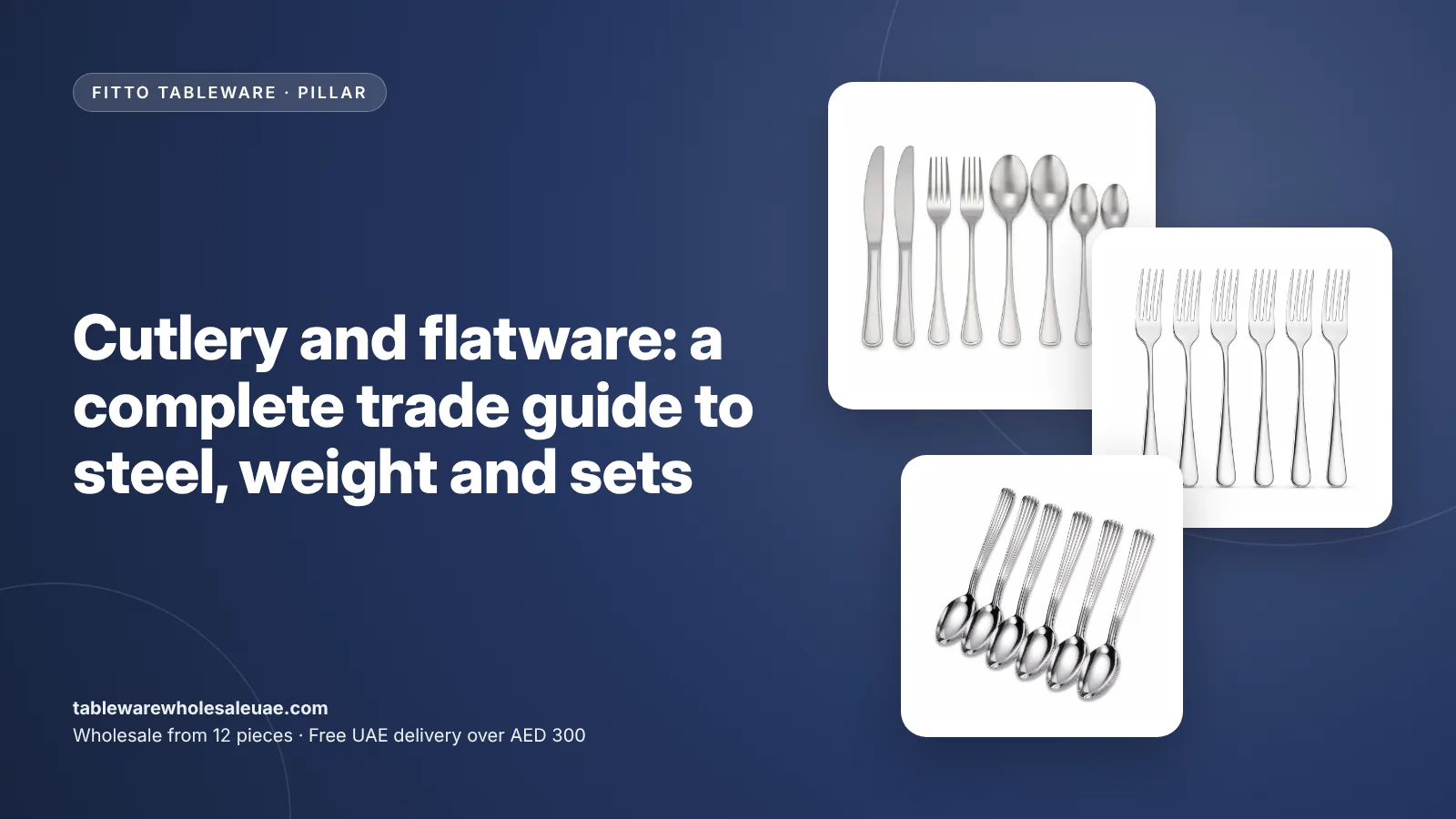
For cutlery wholesale in the UAE, choose 18/10 or 18/8 stainless steel forks and spoons for busy service, 13/0 steel for knife blades, and 18/0 only where pieces are dried promptly. Pick forks and spoons around 2 mm thick, plan four core pieces per cover, and stock three of each per seat.
Key takeaways
- The numbers on cutlery show chromium and nickel content: more nickel means better shine and fewer spots.
- A magnet test on one sample tells you more than a vague "stainless steel" label.
- Medium-weight cutlery, around 2 mm thick, suits most restaurants, cafés and homes.
- Restaurants need three of each core piece per seat; families need about two per person plus guests.
- Most rust spots come from water, salt and soaking, not from the steel itself, so drying matters as much as grade.
Cutlery looks like the simplest part of a table, yet small problems show there first. Thin forks bend, cheap knives spot within weeks and teaspoons quietly vanish. Every replacement order costs money and time, and a mixed drawer makes a good table look careless.
This guide settles what to buy: the pieces, the steel, the weight, the finish and the quantities. It is for restaurant and hotel buyers, office and canteen managers, resellers and households furnishing a new villa or apartment. At FITTO Tableware, a wholesale tableware supplier in the UAE, we stock cutlery and flatware (أدوات المائدة) from boxed sets and table knives to serving spoons, rice spoons and coffee spoons.
What pieces make up a cutlery set?
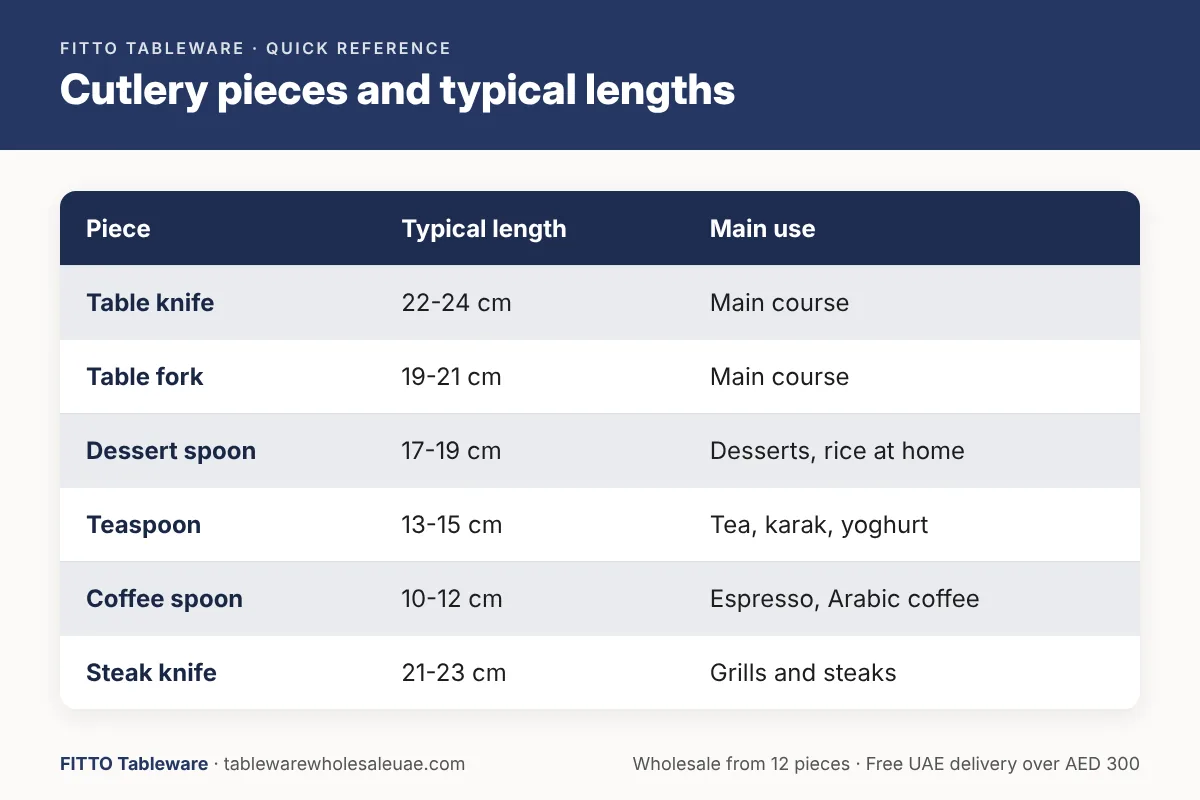
A basic set has four core pieces per person: table fork, table knife, dessert spoon and teaspoon. Add steak knives, soup spoons or coffee spoons only when your menu or home routine needs them.
"Flatware" is the American word and "cutlery" the British one; UAE suppliers and buyers use both for the same thing. The lengths below are typical industry ranges, and every pattern varies a little.
| Piece | Typical length | Main use |
|---|---|---|
| Table knife | 22–24 cm | Main course |
| Table (dinner) fork | 19–21 cm | Main course, with the knife |
| Table spoon | 19–21 cm | Rice dishes, soup, serving at home |
| Dessert spoon and fork | 17–19 cm | Desserts, breakfast, children's meals |
| Teaspoon | 13–15 cm | Tea, karak, yoghurt |
| Coffee spoon | 10–12 cm | Espresso, Arabic coffee, sugar bowls |
| Steak knife | 21–23 cm, serrated | Grills and steaks |
In many UAE homes the dessert spoon does double duty for rice and curry, so families often buy more dessert spoons than forks. Restaurants serving Asian menus add Chinese soup spoons, such as 14–15 cm melamine spoons, and chopsticks, such as 26 cm bamboo pairs.
Which stainless steel grade should you buy?
For forks and spoons, 18/10 or 18/8 stainless steel is the safe choice for heavy use; for knife blades, 13/0 steel holds an edge better. 18/0 costs less and works well where pieces are dried straight after washing.
The first number is the percentage of chromium, which makes steel stainless. The second is nickel, which adds shine and resistance to spotting.
| Grade | Chromium / nickel | Spotting resistance | Magnetic | Best for |
|---|---|---|---|---|
| 18/10 | 18% / 10% | Highest | Generally no | Hotels, fine dining, gifts |
| 18/8 | 18% / 8% | High | Generally no | Busy restaurants, cafés |
| 18/0 | 18% / 0% | Moderate; dry promptly | Yes | Canteens, budget household sets |
| 13/0 | 13% / 0% | Moderate | Yes | Knife blades |
You may also see "201" on some listings. It is a lower-nickel steel that resists spotting less well than 18/8, so treat it like 18/0 and dry it promptly.
A magnet is the quickest check on a sample: 18/10 and 18/8 forks and spoons are generally non-magnetic, while 18/0 is magnetic. Knives are magnetic in almost every set, because their blades use hardenable 13/0 steel. When a product page says only "stainless steel", test one sample before you order a full quantity. For the full comparison, read 18/10 vs 18/0 cutlery.
How heavy should cutlery be?
Cutlery should feel solid and should not flex when you press the fork tines on a plate. As a rule of thumb, forks and spoons around 2 mm thick hold their shape in daily service, while very thin pieces bend against a firm steak or frozen dessert.
| Weight class (rule of thumb) | Thickness | Feel | Best for |
|---|---|---|---|
| Light | Under about 1.5 mm | Flexes under pressure | Takeaway counters, events, staff canteens |
| Medium | About 2 mm | Firm, balanced | Cafés, restaurants, family homes |
| Heavy | 2.5 mm or more | Substantial, premium | Hotels, fine dining, gift sets |
Heavier is not always better. Heavy cutlery costs more to replace when it goes missing, and it feels awkward for children. Balance matters as much as weight: hold a fork at the point where the handle meets the neck, and it should rest level rather than tip sharply.
Which finish and handle style should you choose?
Mirror or satin polish on plain stainless steel lasts longest; coloured, gold-tone and wooden handles need gentler care.
- Mirror polish: bright and classic. It shows fingerprints but polishes back easily.
- Satin (brushed): hides fine scratches better, so it suits busy restaurants and canteens.
- Coloured handles: useful for colour-coding, such as a staff set kept apart from guest cutlery. Our 12-piece table knife set with coloured handles is built for this.
- Gold-tone: a coloured finish over the steel for coffee, dessert and majlis service. Wash gently by hand to protect it.
- Wooden handles: warm and comfortable on serving spoons. Hand wash and dry at once, because long soaks crack wood.
- Silver-plated holders and display pieces: hand wash, and keep them away from stainless steel in the dishwasher, where contact can mark the plating.
For restaurants and hotels, plain steel handles are the default because they are the easiest to wash and match on reorder. Decorative finishes earn their place in coffee service, gifting and the majlis.
How many pieces of cutlery does each cover need?
Plan four core pieces per cover, then stock three of each per seat: one on the table, one in the wash and one in reserve. A café with a slow wash-up may need four per seat. These multipliers are rules of thumb; adjust after a month of counting.
| Piece | Per cover | 20 seats (×3) | 50 seats (×3) | 100 seats (×3) |
|---|---|---|---|---|
| Table fork | 1 | 60 | 150 | 300 |
| Table knife | 1 | 60 | 150 | 300 |
| Dessert spoon | 1 | 60 | 150 | 300 |
| Teaspoon | 1 | 60 | 150 | 300 |
| Steak knife (if on menu) | 1 | 60 | 150 | 300 |
For homes, the maths is simpler. A family of five needs five of each core piece in daily use, plus the same again for guests and dishwasher cycles, so 12 of each is a comfortable number. Our restaurant cutlery sets guide covers how to stop restaurant cutlery going missing, and the restaurant tableware checklist puts cutlery into a full opening order.
Which serving utensils does a buffet or family table need?
Plan one serving utensil per dish, plus about 25% spare for swaps when one drops or gets sauced. Long handles matter: 28 cm or more reaches the bottom of a deep hotpot or rice platter without the server's hand touching food.
The FITTO range covers the main jobs:
- Serving spoons from 28 to 37 cm, including a 6-piece stainless steel set and a 37 cm spoon with a wooden handle for deep pots.
- Rice spoons and sporks in 23, 26 and 29 cm stainless steel, for machboos, biryani and kabsa.
- Serving fork, 30 cm, with a hanging hook for grills and salads.
- Noodle server, 30 cm, for pasta and noodle stations.
- Melamine rice and curry ladles of 30–32 cm that match melamine serveware.
For a full 50-guest buffet list, see our catering serveware essentials.
Should you buy boxed sets or open stock?
Buy open stock (single-piece types) for restaurants and canteens, and boxed sets for homes, gifting and retail. Open stock lets you replace only the teaspoons you lose; a boxed set looks complete on a shelf and suits a first apartment.
| Buyer | Better choice | Why |
|---|---|---|
| Restaurant or hotel | Open stock by piece type | Replace only what goes missing; match on reorder |
| Staff canteen or office pantry | Open stock, satin finish | Hides scratches; easy to top up |
| Household | Boxed set plus extra spoons | Matching look; spoons run out first |
| Gift shop or reseller | Boxed sets and coffee spoon sets | Ready to gift; clear contents |
| Majlis and coffee service | Gold-tone coffee spoons with holder | Presentation matters more than volume |
FITTO examples include an 8-piece stainless steel cutlery set in a display tray, a 6-piece table knife set, gold-tone coffee spoons in sixes, and a 7-piece gold-tone coffee spoon set with an ornate holder. Whichever route you take, stay with one pattern so every reorder matches.
How do you wash and store cutlery in the UAE?
Rinse soon after use, wash, then dry at once. Spots and rust marks usually come from water, salt, acidic food and detergent left on the steel. Summer humidity makes drawers damp, so drying matters even more between June and September.
- Rinse food off within the hour, especially salt, lemon, vinegar and tomato.
- Do not soak overnight. Long soaks in salty or bleach-based water cause pitting.
- Load the basket with forks and spoons handles down so the eating ends get the full spray; load knives handles up for safety.
- Separate metals. Keep silver-plated or gold-tone pieces away from plain stainless steel.
- Dry and polish with a lint-free cloth while still warm, especially 18/0 and knife blades.
- Store dry in a ventilated tray, not a sealed box, and wipe any spot with a mild cleaner before it sets.
If your water leaves white marks after drying, add rinse aid to the dishwasher. Reorder when stock falls below two of each piece per seat.
What should you check before buying cutlery wholesale in the UAE?
Check the grade, the finish and the feel on one sample before you commit to volume. A five-minute inspection saves a season of complaints.
- Grade: is it stated, and does the magnet test agree with it?
- Edges: run a finger along tines and spoon rims; there should be no burrs or sharp seams.
- Tines: they should be even, straight and the same length.
- Weight and balance: the fork should not flex under firm pressure and should rest level near the neck.
- Finish: polish should be even, with no cloudy patches or scratches from the factory.
- Handles: coloured, wooden or plastic handles should sit tight with no gaps where water can enter.
- Continuity: choose a line you can reorder, because a mixed drawer looks worse than a cheaper matching one.
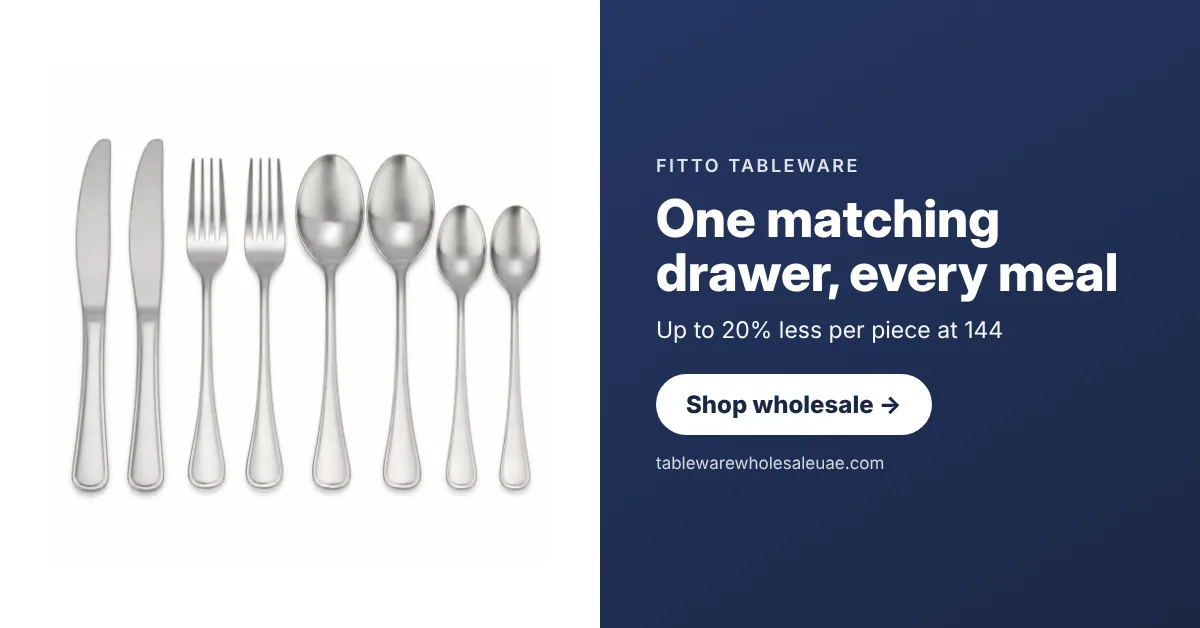
FITTO Trade Pick: One matching drawer, from table to buffet Start with the 8-piece stainless steel cutlery set in a display tray, add the 6-piece table knife set, the 6-piece serving spoon set and gold-tone coffee spoons for coffee service. Sets count as one piece, and bigger packs cut the price per piece by up to 20% at 144.
The bottom line
Good cutlery is a grade, a weight and a quantity decision, not a style one. Choose 18/10 or 18/8 for heavy use, around 2 mm thickness, three pieces per seat for restaurants, and one pattern you can reorder.
Browse our wholesale cutlery and flatware and matching serveware sets and dispensers, with packs from 12 to 144 pieces and free delivery to all seven emirates over AED 300. For outlet quantities, request a quote; to test the weight and magnet check in hand, order a sample with its cost credited on a bulk order of AED 2,000+ within 30 days, or WhatsApp +971 55 672 6947. FITTO Tableware: fit for the way you serve.
FAQ
What is the difference between cutlery and flatware?+
There is no practical difference: both mean the knives, forks and spoons used to eat and serve. "Cutlery" is the British term, used across the UAE and Gulf, while "flatware" is the American term. Some suppliers use "flatware" to include serving pieces, so check what a listing actually contains.
Is 18/0 cutlery good enough for everyday use?+
Yes, if it is dried promptly. 18/0 stainless steel has no nickel, so it is more prone to water spots and light rust marks than 18/10 or 18/8. It suits staff canteens, events and budget household sets. For a busy restaurant with a hot commercial dishwasher, 18/8 or 18/10 lasts longer between replacements.
How many cutlery sets does a family need?+
Plan about two of each core piece per person, plus extras for guests. A family of five is comfortable with 12 table forks, 12 knives, 12 dessert spoons and 12 teaspoons. Families who host often, or eat rice dishes with spoons, should add another 6 dessert spoons and teaspoons.
Why is my stainless steel knife magnetic?+
Most table knife blades use 13/0 stainless steel, which is magnetic and can be hardened to hold an edge. That is normal, even in an 18/10 set. If forks and spoons labelled 18/10 are strongly magnetic, they are more likely 18/0, so ask the supplier to confirm the grade.
Can gold-tone cutlery go in the dishwasher?+
Hand washing is the safer choice. Gold-tone cutlery has a coloured finish over the steel, and strong dishwasher detergent, high heat and contact with other metals can dull or mark it over time. Wash with a mild detergent and a soft sponge, rinse, and dry at once with a soft cloth.
What length should a serving spoon be?+
For buffets and deep dishes, choose 28 to 37 cm so the hand stays clear of hot food. A 28–32 cm spoon suits salads and sides, while 34–37 cm suits deep hotpots and rice platters. For portioning rice, a 26–29 cm rice spoon or spork gives more control.