Tableware merchandising: how retail shops display plates, glasses and mugs to sell more
By FITTO Trade Desk · Last updated 29 October 2026
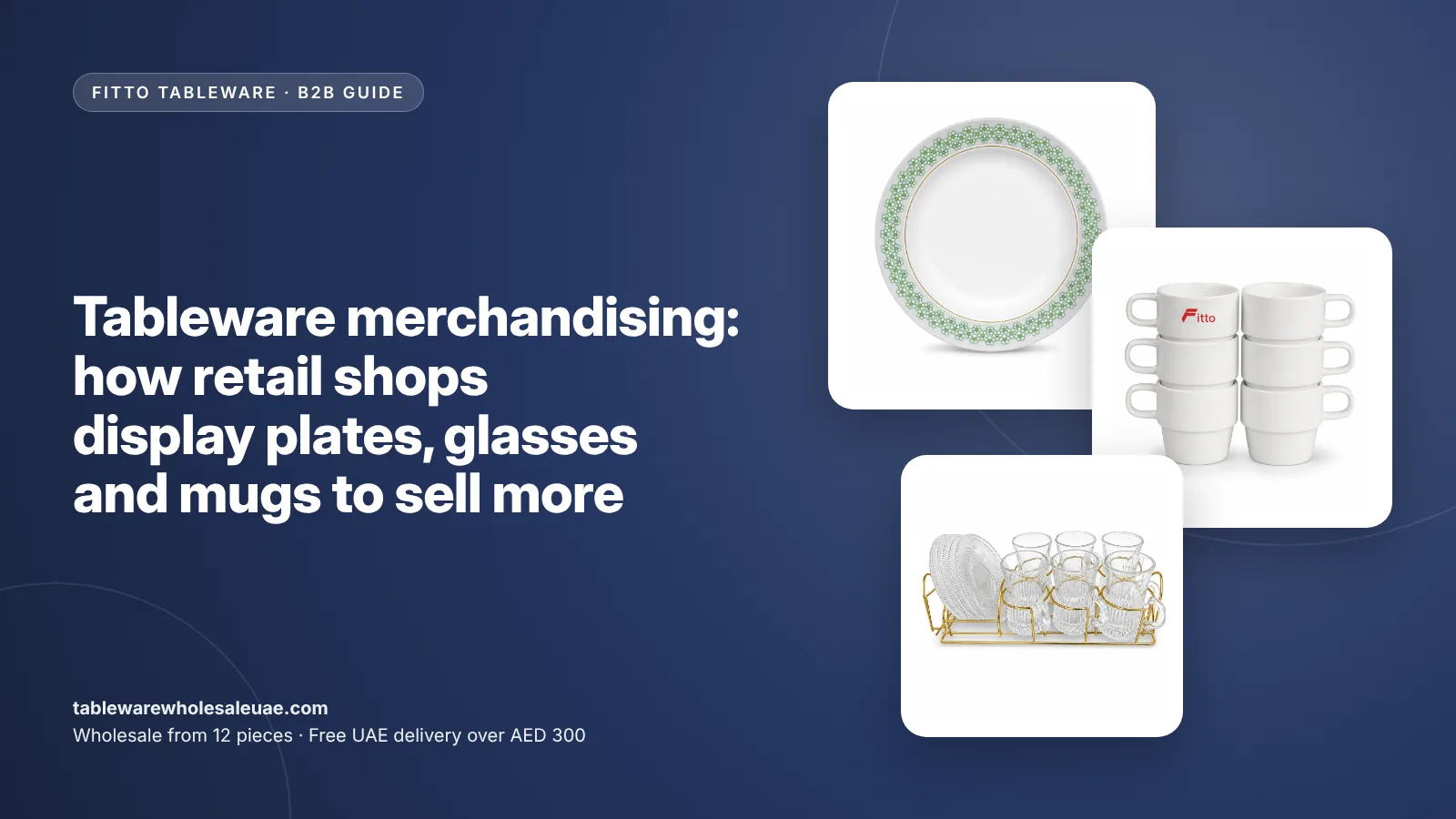
Tableware merchandising sells more when shoppers see a finished table, not just shelves of stock. Set one feature table near the entrance, run category walls for plates, glasses and mugs, and group each wall by collection and price tier. Put best sellers at eye level, heavy items low, and reorder before facings empty.
Key takeaways
- A set feature table sells the whole place setting; a shelf of loose plates sells one plate.
- Group by collection, then by good, better and best price tiers, so shoppers compare like with like.
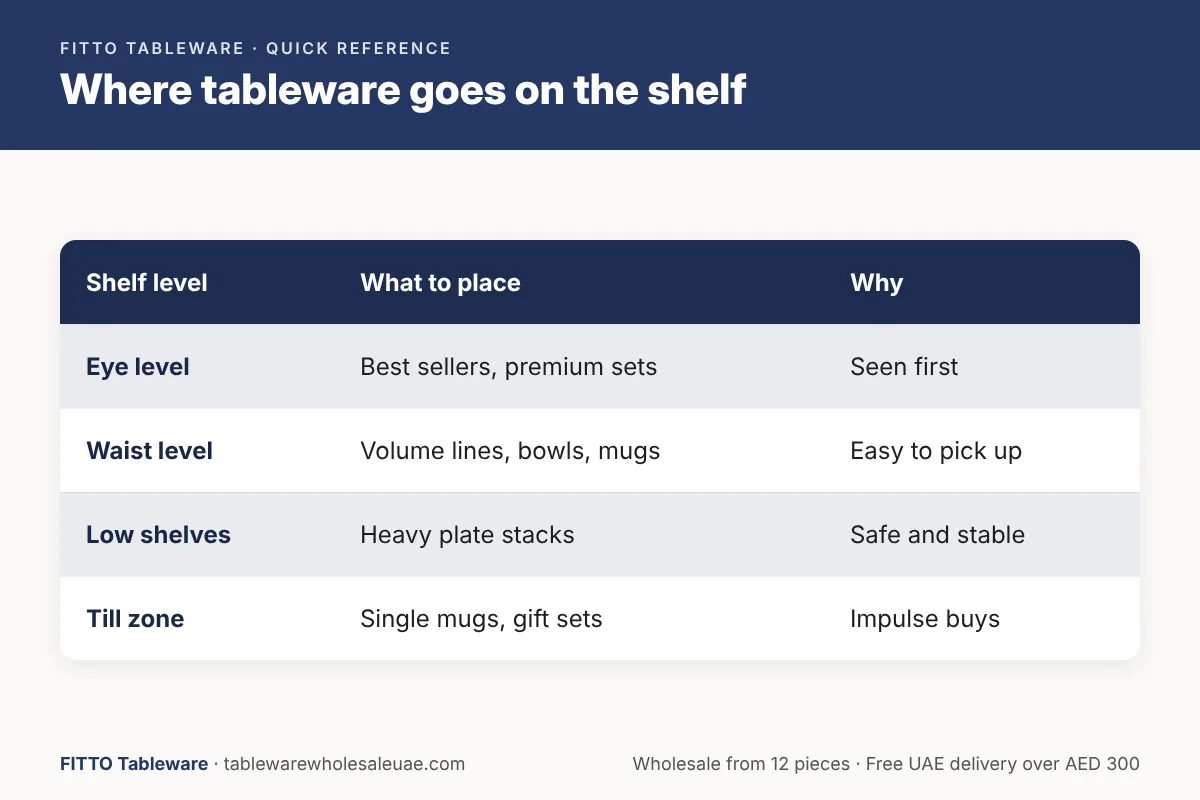
- Eye level for best sellers and premium sets, waist level for volume, low shelves for heavy stacks.
- Reorder from sales data and lead time, not from empty shelves.
Good tableware merchandising is the difference between a shopper buying four mugs and buying a full dinner set. Many UAE homeware shops stock similar products; the ones that sell more make the finished table easy to picture.
This guide is for shop owners and retail managers selling tableware (أدوات المائدة) in malls, high streets and neighbourhood stores. At FITTO Tableware, a wholesale tableware supplier in the UAE, we supply plates, glassware, mugs and serveware to resellers across the emirates. Below are the layouts, sets, price tiers and reorder signals that move stock.
How should a tableware shop be laid out?
Use three zones: a feature table near the entrance, category walls around the sides and small impulse items at the till.
- Entrance landing zone. Leave the first metre or two clear; shoppers rarely stop the moment they walk in.
- Feature table. Lay a complete table for four or six with plates, bowls, glasses, cutlery and placemats. Change it monthly or for each season.
- Category walls. Run plates and bowls, glassware, mugs, serveware and table linen as separate bays, in that logical order.
- Till zone. Place single mugs, small bowls and gift-boxed sets where people queue.
For the wider picture of opening a shop, see our guide to starting a tableware shop in the UAE.
How do you display plates, glasses and mugs?
Show one piece open and styled, and keep the rest stacked or boxed behind it. Shoppers see the pattern; staff keep tidy, safe stock.
| Product | How to display | Shelf position | Rule of thumb |
|---|---|---|---|
| Plates | One plate upright on a stand, stack behind | Waist to low | Keep stacks low enough to lift safely |
| Bowls | Nested in threes by size | Waist level | Show the full size range side by side |
| Glassware sets | Boxed sets, one open sample in front | Eye level | Keep away from aisle edges and small children |
| Mugs | Handles all facing the same way | Eye to waist | Block by colour, not by supplier |
| Gift sets | Open lid or display tray, price on top | Eye level, near till | Show the piece count clearly |
Plates sell on pattern, so stand one upright. Glassware sells on light: glass shelves and a spotlight make ribbed glass sparkle. Mugs sell in colour blocks with handles lined up. Our best-selling mug designs list shows which prints move fastest.
How do you build sets that raise basket size?
Display coordinated pieces together as a ready-made place setting, and label the complete set. Shoppers who see a finished table often buy the whole look.
Open-stock ranges are ideal for this. For example, FITTO's green and yellow pattern runs across a 10 inch melamine dinner plate (26 cm), an 8 inch soup plate, a 4.5 inch rice bowl and a green-patterned water mug. Add a gold-tone PVC table mat (38 x 38 cm) and an 8-piece stainless steel cutlery set in a display tray, and one place setting becomes six sales.
Three set ideas that work in UAE shops:
- Family dinner for four: dinner plates, soup plates, rice bowls, mugs and placemats.
- Majlis tea set: a ribbed glass cup and saucer set with gold metal rack (100 ml), a tray and a dates bowl.
- New home starter: a white ceramic mug set of 6 in a divided retail box, plain plates and cutlery.
For styling ideas that fit small apartments, see our table setting ideas for apartments.
How should you group price points?
Group each category into good, better and best tiers, and keep each tier together on the shelf. Mixed prices on one shelf confuse shoppers and slow decisions.
- Good: plain white plates, basic tumblers and single mugs. Place them in volume at waist and low levels.
- Better: patterned melamine ranges, ribbed glass and boxed mug sets. Give them most of your facings.
- Best: gold-rim glass sets, tiered stands and gift boxes. Put them at eye level and on the feature table.
As a starting point, give roughly half your facings to the middle tier, a third to entry and the rest to premium. Then adjust by sales. Always show the piece count beside the price: "12 pieces: 6 cups, 6 saucers" removes the most common question.
What reorder signals should a tableware shop watch?
Reorder when stock falls to your reorder point, not when a shelf empties. A simple formula works: average weekly sales × (lead time in weeks + one safety week).
| Signal | What it means | Action |
|---|---|---|
| Facings gap for more than a day | Back stock is not keeping pace | Raise the reorder point |
| Fewer than 2–3 weeks of cover | Sell-out risk before the next delivery | Reorder now |
| Over 12 weeks of cover | Slow line tying up cash | Move to the feature table or bundle it |
| Seasonal peak approaching | Demand will jump | Order 6–8 weeks ahead |
Plan for UAE peaks: Ramadan and Eid, White Friday in November and National Day on 2 December. The Dubai Shopping Festival runs over December and January, and back-to-school falls in late August.
How do you order stock for displays?
Order by pack size and keep a little extra for display breakage. Most FITTO orders are dispatched from Dubai within 2–3 working days, so a one-week lead time is a sensible planning figure.
Every product comes in packs of 12 to 144 pieces, and a set counts as one piece. Bigger packs lower the price per piece, by up to 20% at 144. Order samples first if you are testing a new range; the sample cost is credited on a bulk order of AED 2,000+ within 30 days. Our wholesale tableware pack sizes guide shows how to match packs to sales.
FITTO Trade Pick: A full place setting from one range Build your feature table with the 10 inch green and yellow melamine dinner plate, the 8 inch soup plate and stackable white ceramic mugs (set of 6). Mixed cartons and regular supply are available on request, so one order can fill a whole display.
The bottom line
Shops sell more tableware when they show a finished table, group stock by collection and price tier, and reorder from sales data. Start with one feature table and one tidy wall per category, then refine by what sells.
Browse our full tableware range, including glassware and cups and mugs, then request a quote for a mixed opening order or order samples. Delivery is free across the UAE over AED 300, and the trade desk is on WhatsApp +971 55 672 6947. FITTO Tableware: fit for the way you serve.
FAQ
How high should plates be stacked on a shop display?+
Keep stacks low enough that a shopper can lift the top plate without tipping the pile, which usually means waist height or below. Heavy opal and melamine dinner plates belong on lower shelves. Stand one plate upright behind each stack so the pattern is visible without unstacking.
How often should a tableware display change?+
Refresh the feature table at least monthly and for every major season, such as Ramadan, Eid, National Day and winter hosting. Category walls can stay fixed, but rotate the end of each bay so regular customers see something new on each visit.
Should glassware be displayed boxed or open?+
Both. Keep boxed sets for stock and safety, and open one sample set in front so shoppers can see the shape and texture. Place open glass at eye level, away from aisle edges and trolleys, and check samples daily for chips.
What sells best at the till in a tableware shop?+
Low-cost, giftable items sell best at the till: single printed mugs, small bowls, toothpick holders and boxed cup sets. They suit impulse buys and last-minute gifts, especially before Eid, Mother's Day and the end of the school year.