Café crockery budget: how to plan your first tableware order
By FITTO Trade Desk · Last updated 29 October 2026
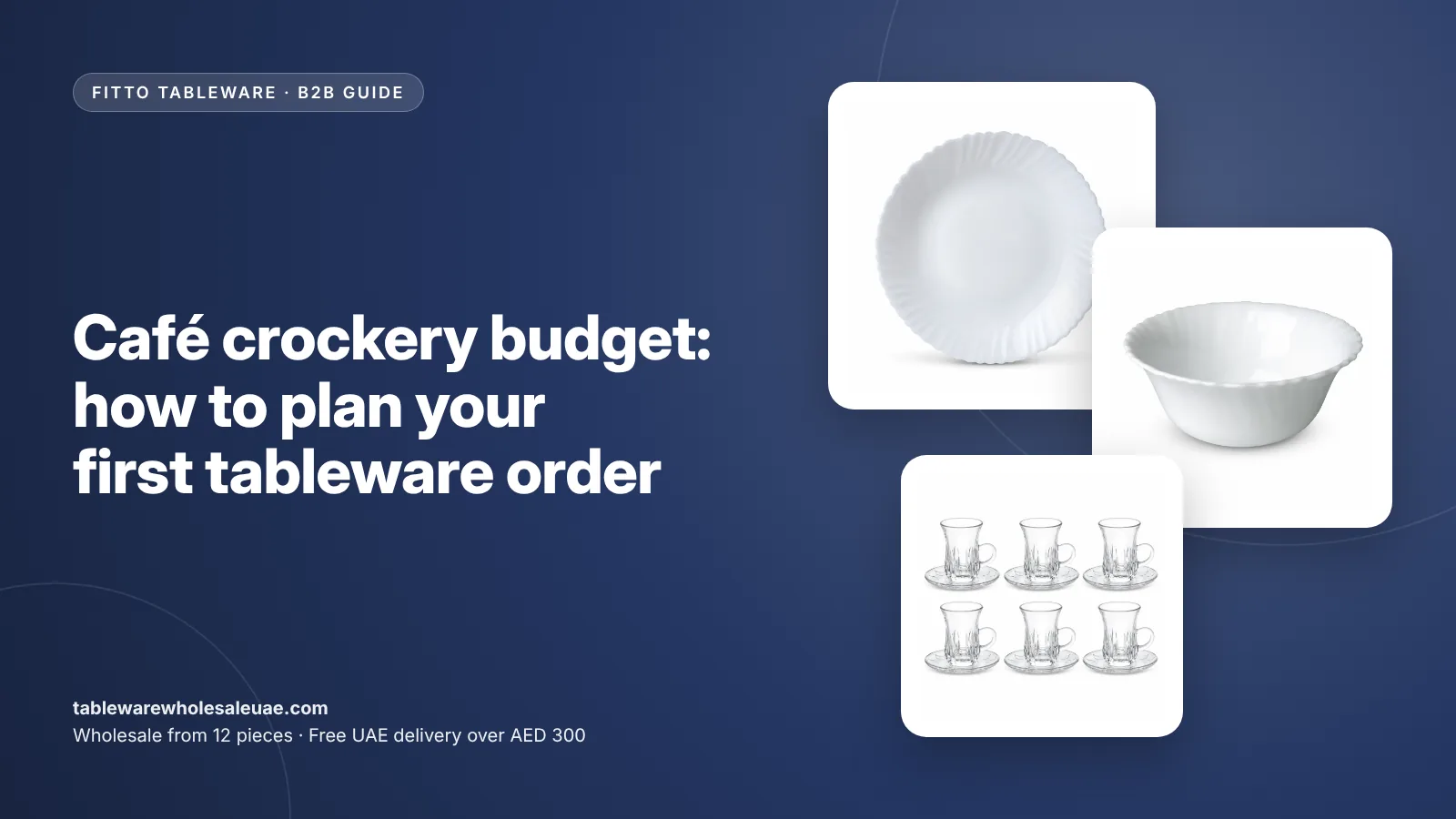
Build a café crockery budget from your seat count, not a shopping list. Multiply seats by a par level for each piece, add 10–15% for breakage, round up to pack sizes and price each line at the pack you will order. A 30-seat café working at 3 cups per seat needs about 90 cups before it opens.
Key takeaways
- Budget per seat: par levels of 3 for cups and 2 for side plates are common rules of thumb.
- Add 10–15% spare for breakage in the first months, then track your real rate.
- A set counts as one piece, so 12 sets of 6 tea glasses give you 72 glasses.
- Compare line totals, not only price per piece, when choosing a pack size.
- Reorder when stock drops below about 80% of par, not when it runs out.
Most café founders budget the coffee machine to the dirham and guess the crockery. Then the first busy Friday arrives, cups run out by 11 am and someone pays retail prices for a mismatched set. This guide shows how many pieces to order and how to turn that into a budget you can defend.
It is written for café founders and managers planning opening costs. At FITTO Tableware, a wholesale tableware supplier in the UAE, we build a lot of first orders, and the ones that work all start from the seat count.
How do you calculate crockery quantities per seat?
Multiply your seats by a par level: the number of each item needed per seat so one is in use, one is being washed and one is ready.
As a rule of thumb, cafés plan 3 per seat for coffee cups, because they turn fastest, and 2 per seat for tea glasses, tumblers and side plates. Food items such as main plates and bowls often run at 1.5 per seat in a café where not every guest eats. Use the higher end if you hand-wash or run a slow domestic dishwasher.
What does a 30-seat café need?
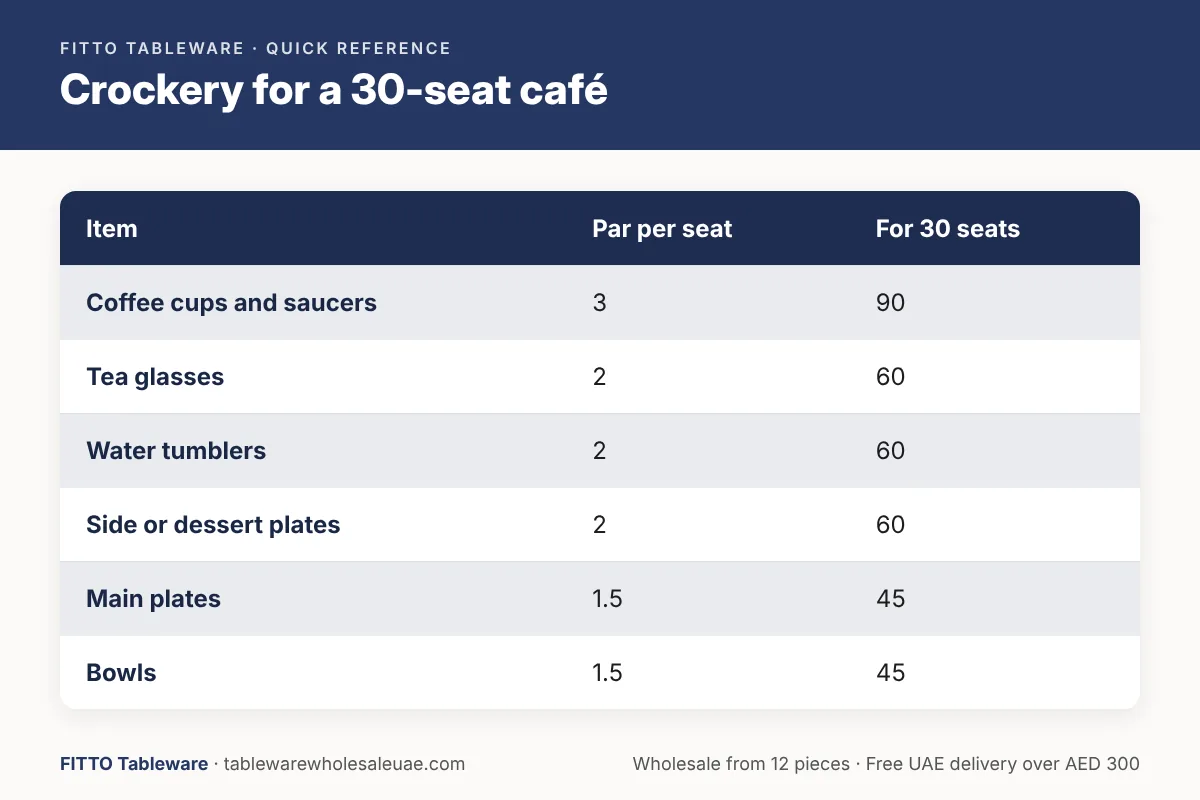
A 30-seat café that serves coffee, tea and light food needs roughly 90 cups, 60 tea glasses, 60 side plates and about 45 bowls before spares. Adjust the par levels to your own menu and washing speed.
| Item | Typical size | Par per seat | For 30 seats | With 15% spare |
|---|---|---|---|---|
| Coffee cups and saucers | 190–220 ml | 3 | 90 | 104 |
| Tea glasses | 110–145 ml | 2 | 60 | 69 |
| Water tumblers | 230–270 ml | 2 | 60 | 69 |
| Side or dessert plates | 7.5–8.5 inch | 2 | 60 | 69 |
| Main plates (food menu) | 9.5–10.5 inch | 1.5 | 45 | 52 |
| Bowls | 5–6 inch | 1.5 | 45 | 52 |
| Teaspoons and dessert forks | Standard | 3 | 90 | 104 |
| Staff serving trays | 36–45 cm | 1 per 8 seats | 4 | 5 |
How much spare should you add for breakage?
Add 10–15% on top of par for the first order, as a rule of thumb, and log breakage from week one.
Breakage runs highest in the first months, while new staff learn the dish area and the stacking routine. Glass and ceramic break more often than opal glass or melamine. Keep a simple log of date, item and cause; after three months you will know your real rate and can trim or raise the buffer.
How do pack sizes change the budget?
Every product is priced per piece in packs of 12, 24, 48, 72 and 144, and a set counts as one piece. The price per piece falls at each step, by up to 20% at 144 pieces.
- Sets: the clear glass tea cup and saucer set holds 6 cups and 6 saucers, so 12 sets give you 72 cups. Always check the count in the product title.
- Steps: on our product pages a 24-piece pack saves 5%, 48 saves 10% and 72 saves 15% on the 12-piece price.
- Totals: if you need 52 bowls, one 48-pack plus one 12-pack gives 60 bowls. A single 72-pack costs only about 11% more in total and gives you 12 extra spares.
- VAT: our prices in AED already include 5% VAT, so do not add it again.
How do you turn quantities into a budget?
Price each line at the pack size you will order, multiply and add the lines up. Six steps cover it.
- List every item and its quantity from the seat table.
- Choose the product and note how many pieces are in each set.
- Convert the quantity into packs.
- Note the price per piece shown for that pack size.
- Multiply and total the lines.
- Hold back about 10% of the crockery budget for top-ups after month one, as a rule of thumb.
| Item | Needed | Pieces per set | What to order | Price to use |
|---|---|---|---|---|
| Tea cups and saucers | 69 cups | 6 + 6 saucers | 12 sets (72 cups) | 12-piece price |
| Side plates, 8.5 inch | 69 | 1 | 72 plates | 72-piece price |
| Bowls, 5 inch | 52 | 1 | 48 + 12, or 72 | Compare both totals |
| Water tumblers, 230 ml | 69 | 6 | 12 sets (72 glasses) | 12-piece price |
Which materials keep a café budget under control?
Opal glass for daily plates and bowls, glass for tea and water, and opal glass or ceramic for coffee cups suit most cafés (مقاهي).
Opal glass is light and resists stains, and usually costs less per piece than ceramic. Keep ceramic for signature cups and plated desserts, and use melamine on terraces and kids' menus. Our opal glass vs ceramic plates comparison covers the trade-offs, and the 12 café tableware essentials list what to skip in month one.
When should you reorder?
Reorder when any item drops below about 80% of its par level, not when it runs out.
Count crockery every week, ideally on Thursday before the weekend rush. Plan for peaks such as Ramadan evenings, winter terrace months and National Day weekends a week or two ahead. For the full opening list beyond crockery, use our restaurant tableware checklist.
FITTO Trade Pick: A café starter range that matches Build the core on the 8.5 inch opal glass dessert plate, the 5 inch opal glass bowl, the glass tea cup and saucer set and the opal glass coffee cups with saucers, 190 ml. Order a sample of each first; the sample cost is credited on a bulk order of AED 2,000+ within 30 days.

The bottom line
Start from seats, apply par levels, add a breakage buffer and only then price the list. Comparing pack totals line by line usually saves more than chasing the lowest unit price.
Send your list for a quote with mixed cartons and pack sizes, browse our plates and bowls and glassware and cups, order samples or WhatsApp +971 55 672 6947. Most orders leave Dubai within 2–3 working days, with free delivery over AED 300. FITTO Tableware: fit for the way you serve.
FAQ
How many cups does a café need per seat?+
As a rule of thumb, plan 3 coffee cups per seat for a busy café: one in use, one in the dishwasher and one ready on the shelf. Slower cafés with a fast commercial dishwasher can work with 2. Tea glasses and water tumblers usually need 2 per seat. Add 10–15% on top for breakage before you place the first order.
How much spare crockery should a café keep?+
Keep 10–15% above par for the first order, stored away from the service area so it is not used as everyday stock. Spares replace breakage without mismatched pieces and cover a sudden rush. After three months, check your breakage log and adjust: a café losing few pieces can cut the buffer, while one with heavy glass breakage may need more.
Should a new café buy opal glass, ceramic or melamine?+
Most new cafés get the best balance from opal glass for everyday plates and bowls, because it is light, stain-resistant and usually cheaper per piece than ceramic. Ceramic suits signature coffee cups and plated desserts where presentation matters. Melamine fits terraces, kids' menus and anywhere drops are common, but it is not for microwave reheating.
When should a café reorder cups and plates?+
Reorder when any item falls below about 80% of its par level, rather than waiting until staff run short. Count crockery weekly, ideally before the weekend rush, and log breakage by item. Seasonal peaks such as Ramadan evenings, winter terrace months and National Day weekends are worth planning for, with stock topped up a week or two ahead.